SellSEO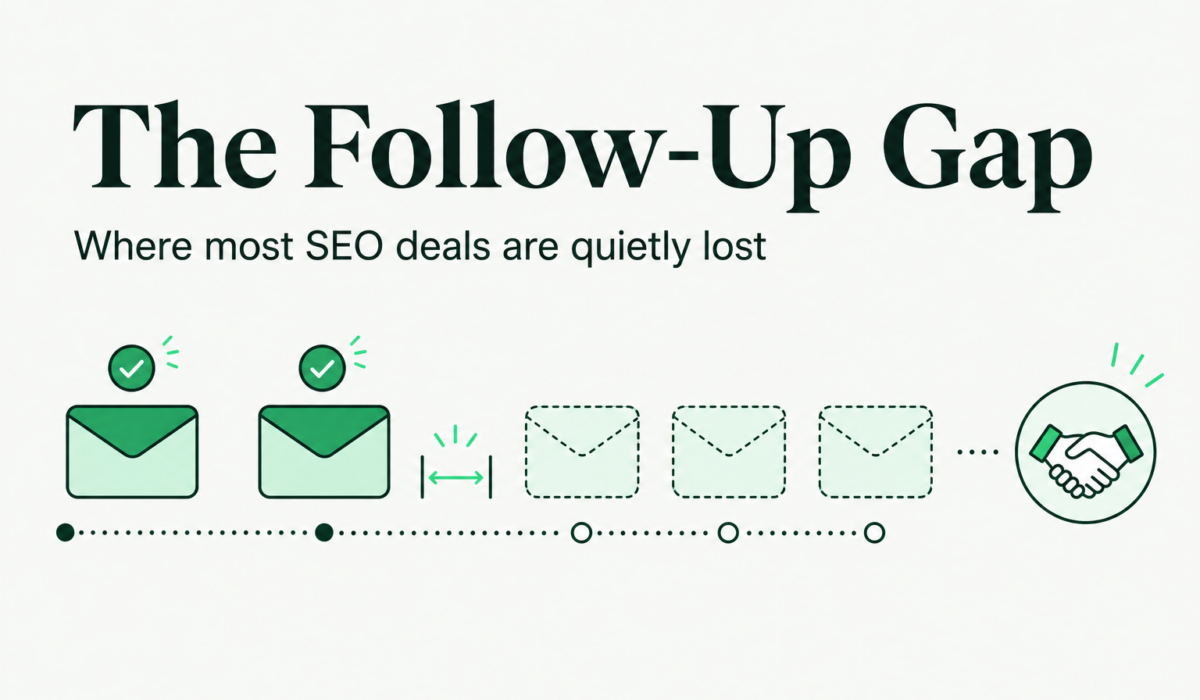
 SellSEO
Ask an agency owner where they lose deals and they will describe a call that went badly, a price that was too high, or a competitor who undercut them. Almost nobody says “I stopped emailing them.” Yet that is where the majority of the losses actually happen, and the numbers on it are not close.
This is the least glamorous article in this series. It is also the one most likely to change your revenue this quarter, because unlike positioning or pricing, it requires no new skill. It requires only that you keep going after the point where you currently stop.
The gap, in numbers
Three figures tell the whole story, and they contradict each other in a way that should be uncomfortable.
Around 80% of sales require at least five follow-up contacts before closing. Meanwhile 44% of salespeople give up after a single follow-up attempt, and by the fourth contact 92% have disengaged entirely.
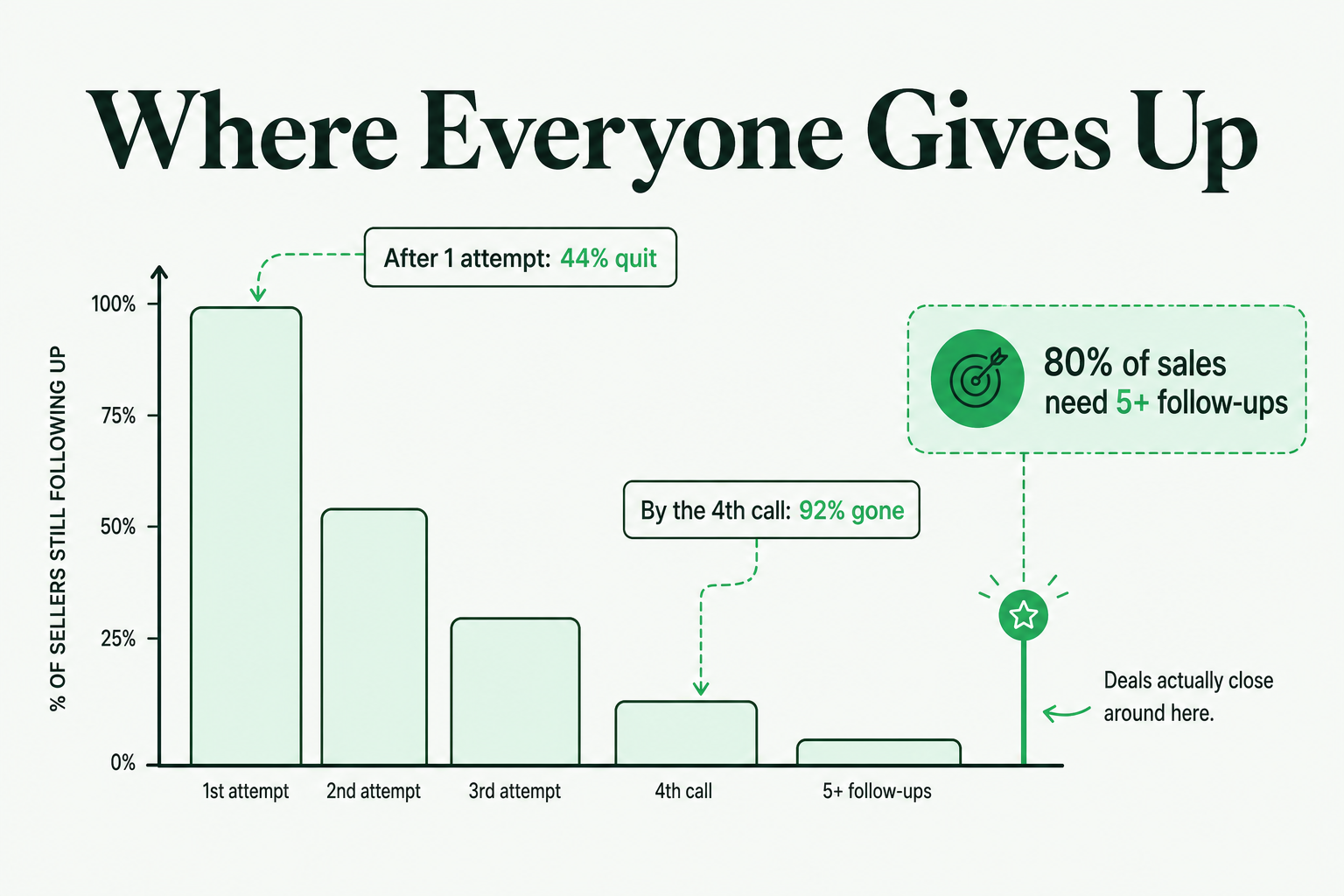
Put those together. Four out of five deals need five or more touches. Nine out of ten sellers have quit before the fourth. The average rep stops at two attempts, and deals close at five or more.
There is a whole market sitting in that gap, and it does not require you to be better at selling than your competitors. It requires you to still be there when they have gone.
The broader range is five to twelve touches depending on deal complexity and how senior the buyer is, with five to seven often cited as the sweet spot. High-growth organisations run up to sixteen touchpoints over a two to four week span.
Why agencies stop early
Almost nobody stops because they decided the lead was dead. They stop for reasons that feel like professionalism at the time.
“I do not want to be annoying.” The most common and the most expensive. It confuses the volume of contact with the quality of it. Five emails that each say “just checking in” are annoying at any frequency. Five emails that each carry something new are not, and buyers routinely report that the persistent vendor was the one who seemed to actually want the work.
Silence read as rejection. No reply feels like a no. It is almost never a no. It is a busy person who opened your email between two other things, meant to come back to it, and did not. A no is information. Silence is just weather.
Nothing new to say. The real reason most sequences die at touch two. The seller has already made their pitch and has no second act. This is a preparation problem rather than a persistence problem, and it is solvable in advance.
No system. Following up manually means remembering, and remembering fails under load. The agency that follows up five times is not more disciplined. It has just written the follow-ups down somewhere that will not forget.
The rule that makes persistence bearable
Every follow-up must carry something the previous one did not.
That single rule solves the annoyance problem, because a message that brings new information is not a nag, it is a service. It also solves the “nothing to say” problem, by forcing you to prepare the second, third and fourth touches at the same time as the first.
For SEO, you have more material than most sellers. Every one of these is a legitimate reason to make contact again:
- A second finding from their site that you did not lead with
- A competitor’s movement, particularly if someone overtook them since you last wrote
- A seasonal search trend arriving in their category
- An algorithm update that affects sites built like theirs
- A result from a comparable client, named or anonymised
- A specific question about their business you genuinely do not know the answer to
Notice that none of these is “following up on my last email.” That sentence is a confession that you have nothing to add, and it trains the recipient to ignore your name in their inbox.
A sequence that earns its five touches
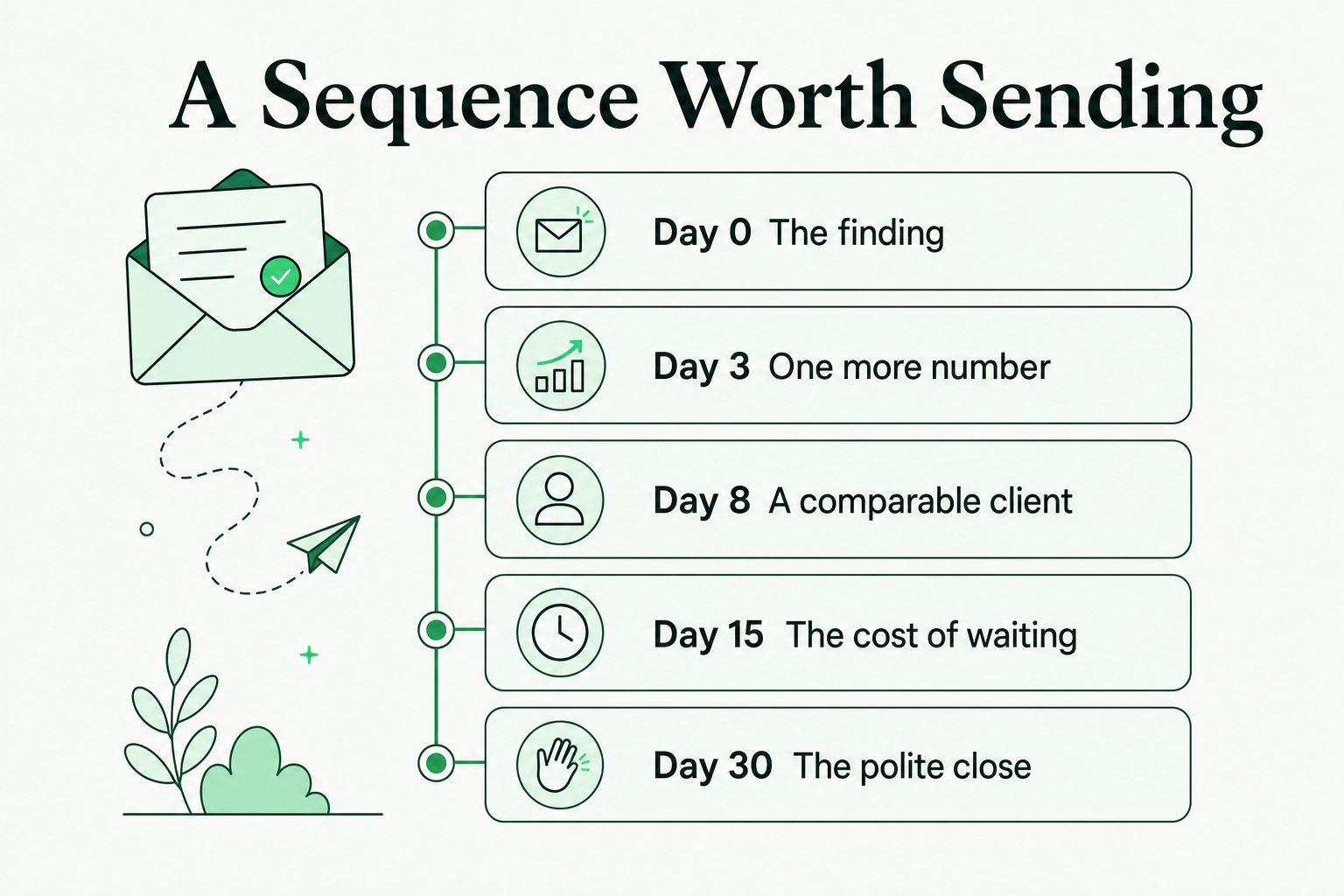
Day 0, the finding. One specific, verifiable problem on their site, translated into money, with a link to the page that proves it. Short. One ask.
Day 3, one more number. A second finding, or the same one with more depth. If they opened the first email and did not reply, reference what they looked at: “I noticed you had a look at the keyword table. The number that surprises most people is the third row.” If they did not open it, the resend with a different subject line does most of the work.
Day 8, a comparable client. This is where proof of your work belongs, not in the opener. By touch three you have earned the right to say “we did this for a business like yours, here is what happened.” Same city or same trade beats an impressive logo from a different world.
Day 15, the cost of waiting. Not a threat, an arithmetic. “Since I first wrote, that gap is roughly another 4,500 dollars of search traffic that went to someone else. It compounds, which is the only genuinely urgent thing about SEO.”
Day 30, the polite close. “I am going to stop emailing. If it becomes a priority later, the audit page stays live at this link and the findings hold. Good luck either way.”
That last message outperforms almost everything else in the sequence, which is a well-observed and slightly annoying fact about human beings. Removing the pressure is what prompts the reply. Send it genuinely, though, and then actually stop. A “final email” followed by three more emails is worse than never sending it.
Speed matters as much as persistence
Persistence gets the deals nobody else waited for. Speed gets the deals everybody else was chasing.
When someone fills in your form, requests an audit or replies to an email, the clock starts immediately and your odds fall fast. The buyer is in the market at that exact moment. An hour later they are back in a meeting, and tomorrow they are talking to two other agencies.
Two practical rules. First, respond to inbound the same day, without exception, even if the response is only “I have seen this, I am looking at your site properly this afternoon and will write back by six.” Second, when a prospect opens your audit page twice in one day, treat that as the strongest buying signal you will get and act on it that day, not in the next scheduled touch.
This is the practical argument for a live audit page over an emailed PDF. The PDF tells you nothing. The page tells you they came back a second time, which is the moment worth interrupting your sequence for.
Automate the reminder, not the message
The obvious objection is that five to sixteen touches across a hundred prospects is unmanageable. It is, by hand.
But there is an important distinction between automating the discipline and automating the relationship. The discipline should absolutely be automated: what to send, when, to whom, and stopping the whole sequence the moment someone replies or books. That is bookkeeping, and software is better at it than you are.
The content is a different matter. A wholly generic sequence produces the “just checking in” emails everyone ignores, and worse, it tells the prospect exactly how much attention they can expect from you as a client. The workable middle is a fixed structure with genuinely specific content in each slot, generated from that prospect’s own data rather than from a template with a merge field.
Two rules that matter more than the tooling. Stop on reply, always, because nothing damages a promising conversation faster than an automated nudge arriving after the prospect has written back. And stop on booking, for the same reason.
Five emails is not the same as five touches
A sequence made entirely of email is a sequence competing with every other email in an inbox that already receives too many. The counts above are touchpoints, not messages in one channel, and mixing channels does more for reply rates than any subject line ever will.
A phone call after the second email changes the arithmetic completely. Most agency prospects, particularly local businesses, are far more likely to answer a phone than to reply to a stranger’s email, and a thirty second call that says “I sent you something about your rankings, did it land” turns an ignored thread into a conversation. If they do not pick up, the voicemail is itself a touch, and it makes your next email recognisable rather than cold.
A connection request or a comment on their company’s post does similar work for a different reason. It attaches a face to the name in the inbox. The prospect who has seen your profile reads your third email differently from one who has not.
The one channel worth using carefully is the one that reaches them personally, whether that is a mobile number or a messaging app. It works, and it can also feel like an intrusion if it arrives before any relationship exists. Save it for later in the sequence, and only where the business itself publishes that number.
Dead leads are not dead
The prospects who said no six months ago are the most underworked pipeline most agencies own, and they cost nothing to reach.
Circumstances change in ways that have nothing to do with you. The agency they chose instead has underdelivered, which happens more often than not. The person who blocked the budget has left. A competitor overtook them in the meantime and someone above them started asking questions. None of that was true when they told you no, and none of it will reach you unless you make contact again.
The re-engagement message that works is not “checking in to see if anything has changed,” which puts the work on them. It is a fresh finding. Run their site again, see what has moved, and lead with that: “You were at position 11 for [term] when we spoke in March. You are at 14 now, and [competitor] has taken the top spot. Thought you would want to know.”
That message is useful whether or not they hire you, which is exactly why it gets replies. Set a reminder ninety days out on every lost deal, and treat it as its own small sequence rather than a single hopeful email.
Track which lost reason came back. Deals lost to budget frequently return within a year. Deals lost to a competitor return when that contract ends, which is usually predictable to within a month or two. Deals lost because the prospect did not believe SEO works rarely return at all, and are worth less of your attention.
What to measure
Most agencies track replies and count everything else as failure. Two better numbers.
Touches per outcome. On the deals you actually won, how many contacts did it take? Almost everyone who measures this for the first time discovers the answer is higher than their standard sequence allows for, which means they have been cutting off deals that were still alive.
Where prospects go quiet. If everyone stops responding after touch two, the problem is that touch two has nothing in it. That is a content problem with a specific location, which makes it fixable.
Open and click rates are worth watching only as timing signals. As a measure of success they mislead, because plenty of deals close after emails that were never opened, off the back of a phone call the sequence prompted.
The short version
Four out of five sales need five or more follow-ups. Nine out of ten sellers are gone before the fourth. You do not have to outsell anyone to win the difference, you have to outlast them.
Make every touch carry something new, prepare all five before you send the first, respond to inbound the same day, stop the moment they reply, and send the polite goodbye at day thirty because it works better than anything before it.
The deals are not being lost on the call. They are being lost in the silence afterwards, by the person who decided that two emails was enough.