SellSEO
 SellSEO
Here is a test for the SEO client report you sent last month. Find the first number on page one. If it is sessions, impressions, or a keyword count, the client skimmed it. If it is a dollar figure they could check against their own bank account, they read it, and they are more likely to still be a client in twelve months. That is the whole difference between a report that documents work and a report that gets you renewed.
This is a template for the second kind. It is five sections long, it takes about forty minutes per client once the data is in place, and the order of the sections is the point: money first, movement second, work third, plan fourth, and a single request at the end. Everything a client wants to know is on page one. Everything you need them to trust is behind it.
Why most reports fail on page one
An SEO report is read by someone who did not buy SEO. They bought more phone calls, more bookings, more quote requests, and they are paying you a monthly fee on the promise that search will deliver those. When the report opens with “organic sessions up 14 percent”, the client has to do the translation themselves: is 14 percent good? What did it cost? Did the phone ring more? Most will not do the translation. They will look at the invoice, look at the graph, and form a vague feeling that they cannot tell whether this is working.
The fix is to do the translation for them, up front, every month, with numbers they can verify. That means three figures on page one and nothing else.
Page one: three numbers
1. Revenue at risk, and how much of it you have recovered
This is the figure you sold them on, and it should appear in every report so they can watch it move. The calculation is simple enough to show them: for each keyword they are close on, the searches per month, times the click share at their current position, times their conversion rate, times what a customer is worth. Add it up. That is the money currently going to competitors. Then show how much of that number has moved from “at risk” to “captured” since you started.
If you used a proof page or an audit to win the client, you already have this number from the first day. Report against it. “When we started, roughly 4,200 dollars a month of search demand for your services was going to three competitors. This month it is 2,900. The difference is 1,300 dollars a month you are now getting, against a fee of 900.” A client who reads that sentence does not cancel.
2. Missed clicks on the near-miss keywords
The second number is the one that explains the plan. Position one takes roughly 28 percent of the clicks on a search. Position six takes around 5. A client sitting at position seven for a keyword with 1,600 searches a month is missing about 370 clicks a month against what position one would deliver. Show the five or six keywords where that gap is biggest, the clicks it represents, and which ones moved this month.
This is more useful than a full ranking table because it tells the client where the next money is. It also quietly sets expectations: they can see that moving from seven to three is worth twice as much as moving from eleven to nine, so they understand why you are working on the keywords you are working on.
3. Leads the client can count
Calls, form fills, bookings, quote requests: whatever the client actually counts, report it, and attribute what you can to search. If tracking is not in place, the first month’s report says so and makes installing it the first deliverable. A report without this number is asking the client to trust you. A report with it is asking them to check.
Page two: what moved
Now the rankings, but as movement rather than a list. Which keywords went up, which went down, and one sentence on why for anything that moved more than three places. If a competitor overtook them, name the competitor; the client already knows who they are and will respect that you do too.
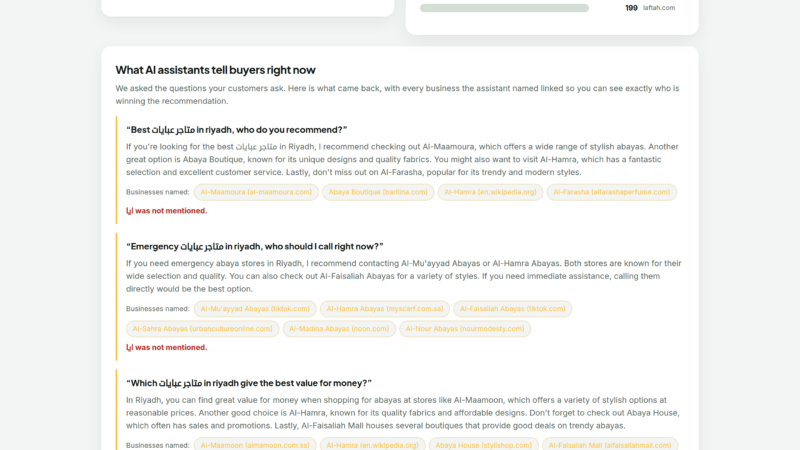
Include the AI answer here as well. A growing share of “who should I hire” questions is asked to an assistant, and if the client is absent from the answer for their own niche and city while three competitors are named, that is a ranking problem they can see with their own eyes. Show the answer. When they finally appear in it, that is a screenshot worth a whole page.
Page three: what you did
The work log, kept short. Pages published, technical fixes shipped, links earned, listings corrected. Clients rarely read this section in detail; its job is to exist, so that when someone in the business asks “what are we paying them for”, there is a list. Bullet points, dated, no adjectives.
Page four: what happens next
Three items, no more. The near-miss keywords you are pushing next month and why. The technical thing you need from them, if any (access, a decision, a photo of the new premises). The one risk you can see coming: an algorithm update, a seasonal dip, a competitor spending on ads. Naming the risk before it happens is the cheapest trust you will ever buy.
Page five: one ask
Every report ends with a single request. Approve the new service page. Send the before-and-after photos. Fifteen minutes on Thursday to walk through the AI answer result. A report that ends with an ask gets a reply, and a client who replies every month is a client who renews.
Automating it without losing the paragraph that matters
Everything above except one paragraph can be pulled automatically: the revenue figure, the near-miss table, the lead count, the rankings movement, the AI answer, the work log. Set the template up once around those figures and the monthly report goes from three days to forty minutes per client.
The one paragraph is the sentence at the top of page one that says, in plain words, what happened this month and what you are doing about it. “Rankings dipped in the second week after the core update, recovered by the fourth, and the emergency plumbing page is now on page one for the first time.” Write that yourself. It is ten minutes a client, it is the only part they will quote to their business partner, and it is the reason they think of you as a person rather than a subscription.
If you want the revenue-at-risk figure and the near-miss table without building the calculation yourself, they are the same numbers a SellSEO scan produces for every business it finds, and the same page that won the client works as the baseline for every report after.