 SellSEO
When somebody asks an assistant who the best plumber in Austin is, they get three or four names and a sentence about each. They do not get ten blue links. For a growing share of buyers, that answer is the entire search.
Which means a new question matters: is your prospect in it?
Ranking and being named are different things
They correlate, but not tightly enough to assume. A business can sit at position four organically and never appear in the recommendation, usually because the sources an assistant leans on, directories, review aggregators, local press, do not mention it.
That mismatch is the useful part. It is a gap the business almost certainly does not know about, and it does not require them to understand ranking factors to feel it.
Ask it properly
One phrasing is an anecdote. The probe asks several natural phrasings of the recommendation question a real buyer would type, live rather than from a cached index, and records who was named, in what order, and whether the business you care about appeared at all.
Live matters. Cached answers age badly, and an assistant is not a stable index you can sample once a quarter.
Use it as evidence, not as a scare
The transcript goes on the audit report, so the prospect sees the actual answer with their competitors in it. That is considerably more persuasive than a paragraph asserting that AI search is important.
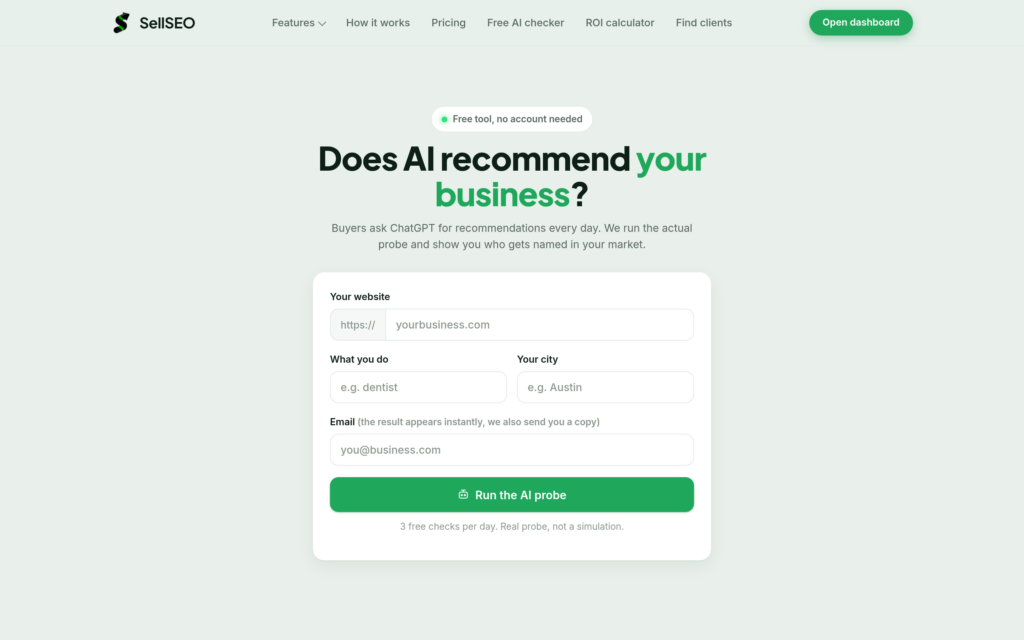
There is a free public checker if you want to see what a market looks like before scanning it, and it works as a lead magnet in its own right.
Why AI visibility is not the same as ranking
Assistants do not read the search results and pick the top one. They lean on sources that summarise a market: directories, review aggregators, local press, industry listings. A business can rank well organically and be absent from every one of those, which is exactly how a strong site ends up unnamed in the answer.
The reverse also happens. A business with a mediocre site that is mentioned everywhere locally gets named repeatedly. This surprises owners, and surprise is a useful state to create in a sales conversation.
How to measure it without fooling yourself
One question asked once is an anecdote. Answers vary between phrasings and between runs, so a single check tells you very little.
Ask several natural phrasings of the same recommendation question, the ones a real buyer would type rather than the keyword you would optimise for, and ask them live. A cached index ages badly here because assistants change more often than search results do.
Record who was named, in what order, and whether the business appeared at all. Order matters, since being third in the answer is a different commercial position from being first.
Turning the gap into a pitch
The pitch writes itself and does not require the owner to understand anything technical. Somebody asked an assistant who to call in their city, three competitors were named, and they were not one of them. That is a complete argument in two sentences.
Put the transcript on the audit report so the claim is verifiable. A prospect who reads the actual answer, with their rivals in it, does not need to be persuaded that it matters.
What actually improves it
The work is closer to digital PR and local citation building than to traditional on-page SEO. Getting mentioned in the sources assistants rely on, keeping listings consistent, earning local press and review volume, matters more than another round of title tag edits.
That is worth saying plainly in the proposal, because it is a different scope from a standard SEO retainer and pricing it as though it were the same is a mistake in both directions.
Frequently asked questions
What is AI visibility tracking?
It is measuring whether a business is named when an AI assistant is asked for a recommendation in its market, which competitors are named instead, and in what order. It is a different measurement from organic ranking and the two correlate only loosely.
Why would a business rank well and still not be recommended?
Assistants lean on sources that summarise a market, such as directories, review aggregators and local press. A business absent from those can rank respectably in organic results and still never appear in the answer.
How often should AI visibility be checked?
More often than you would check rankings, because assistant answers move faster than search results. Checking live at the moment you need the evidence is more reliable than sampling a cached index quarterly.
Is there a free way to check AI visibility?
Yes, there is a public checker that asks the recommendation question for a niche and city without an account, which also works as a lead magnet on your own site.
How do you improve AI visibility?
By earning presence in the sources assistants draw on: consistent local listings, review volume, local press and industry mentions. It resembles digital PR and citation work more than on-page optimisation, and it should be scoped and priced accordingly.
Related reading
- SEO Lead Generation Software: What a Scan Actually Reads
- White Label SEO Audit Reports You Can Send in One Click
- A Free SEO Audit Widget That Hands You the Domain and the Email
- How to Find SEO Leads That Are Provably Losing Money
See the full feature: Ai Visibility.