SellSEO
Most SEO lead lists are just business lists. Every plumber in Austin, every dentist in Denver, scraped into a spreadsheet and mailed the same opener. The reply rate tells you what the prospect thought of it.
A lead is different from a business. A lead is a business you can prove is losing money to search right now: ranking seventh for a phrase 6,600 people type every month, buying Google Ads to paper over an organic position nobody sees, or missing entirely from the answer ChatGPT gives when someone asks who to call. That proof is the difference between a cold email and a conversation.
Here is the process we use, start to finish.
Step 1: Point the engine at one niche and one city
Resist the urge to scan a whole country. Search results are local, and a country-wide sweep averages away the exact signal you are hunting: the gap between what a market searches for and who actually shows up for it. One trade, one metro.
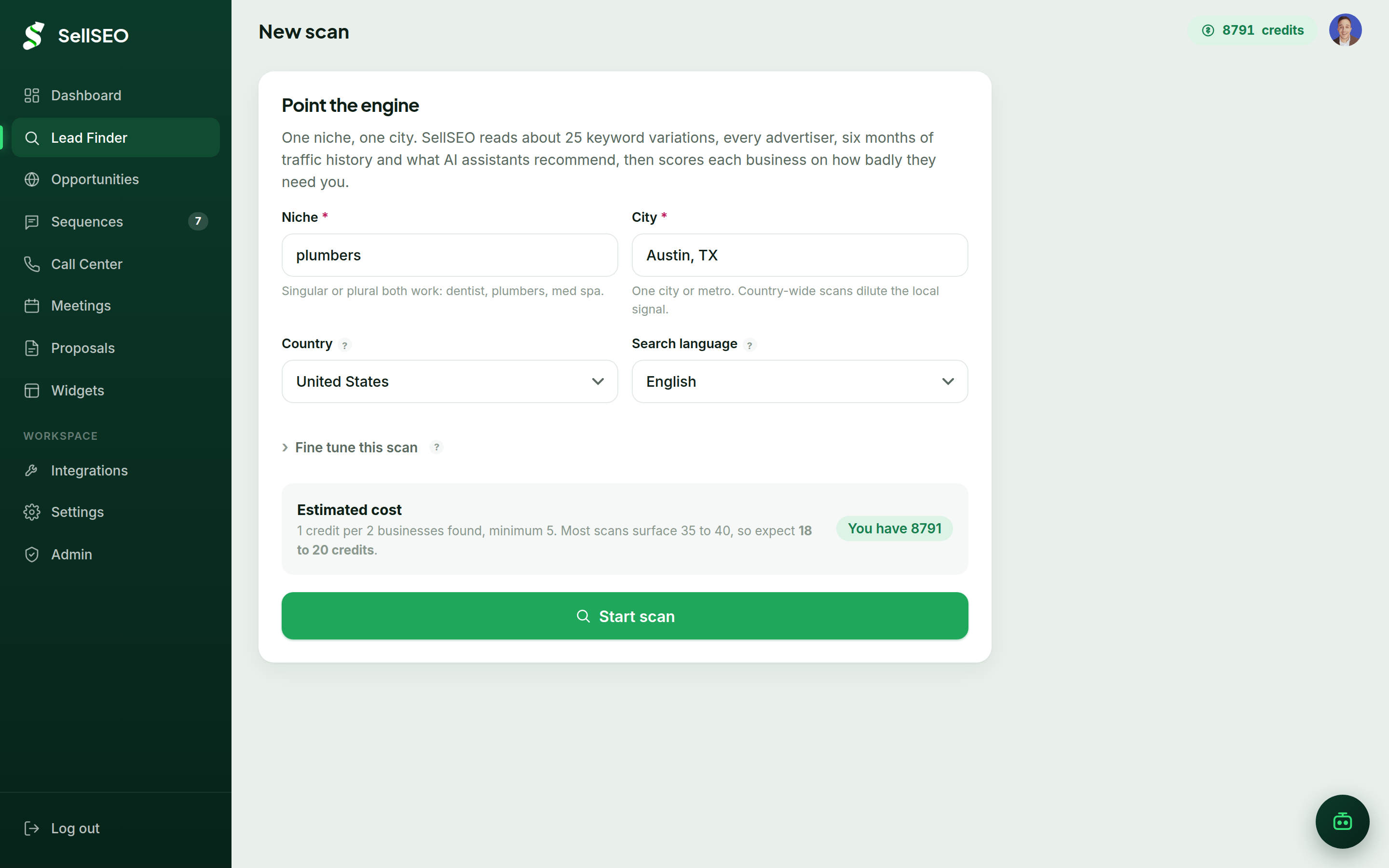
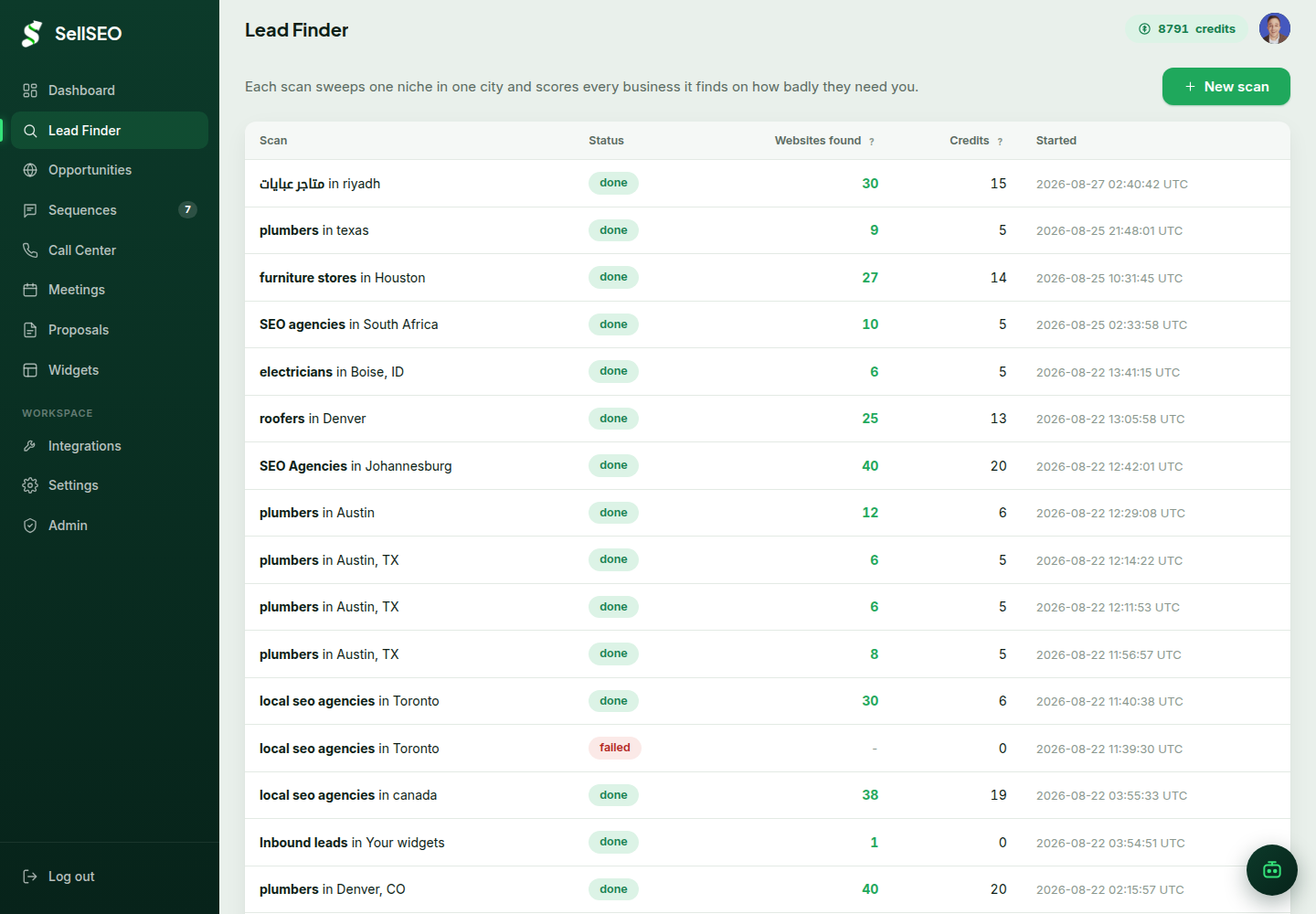
Cost is worth understanding before you start. Scanning charges by what it finds, not by what it tries: one credit per two businesses, minimum five. A typical metro sweep surfaces 35 to 40 businesses and costs 18 to 20 credits, and the estimate is on screen before you commit.
Step 2: Let it read the market properly
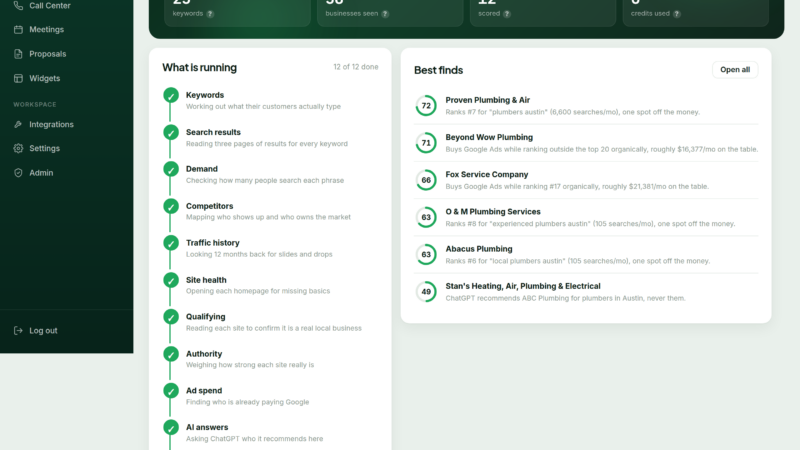
A scan is not a scrape. It works out roughly 25 keyword variations real customers type, reads three pages of results for each one, checks how much demand sits behind every phrase, maps who owns the market, pulls twelve months of traffic history looking for slides, opens each homepage for missing basics, confirms the business is genuinely local, weighs how strong each site really is, finds who is already paying Google, and asks ChatGPT who it recommends in that city.
That last one matters more every quarter. A business can rank respectably and still be invisible in the answer an AI assistant gives, and that is a gap most agencies are not yet selling against.
Then it scores every business on how badly they need you. Runs take a few minutes and land in your scan history, so you can start several and come back.
Step 3: Read the signal, not just the score
Each business comes back with a score out of 100 and, more usefully, a plain sentence explaining it. The sentence is the part you can sell with. Three patterns are worth learning to recognise:
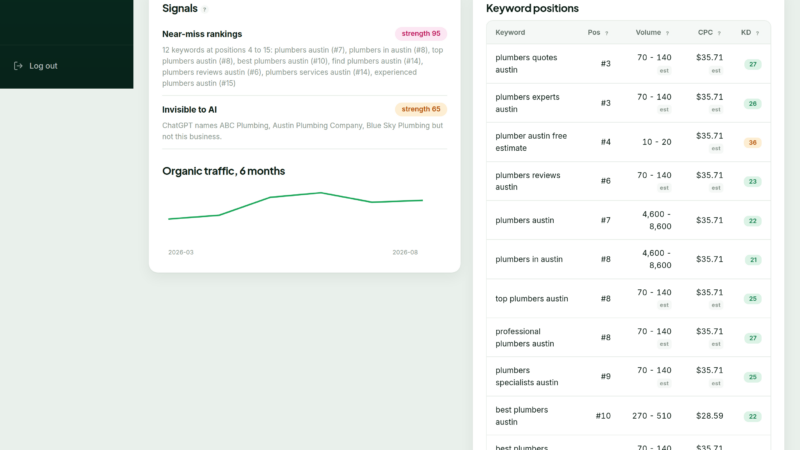
- Near-miss rankings. Sitting at position six, seven or eight for a phrase with real volume. They are one page of work away from the traffic, and they can see the competitors who are already there.
- Buying ads with weak organic. The strongest signal of all. They have already decided search is worth paying for, which means the budget conversation is over before it starts. You are only arguing about which channel.
- Invisible to AI. An assistant asked for a recommendation in their city names somebody else. Show an owner that and the meeting books itself.
A 63 with “buys ads, weak organic” is a better prospect than a 72 with nothing but a near miss. Sort by score to triage, then read the sentences.
Step 4: Work the top of the list, not all of it
A scan of one city will hand you dozens of businesses. You are not going to pitch dozens well. Take the three or four with the strongest signals and put real effort into those, rather than spreading a template across the whole list.
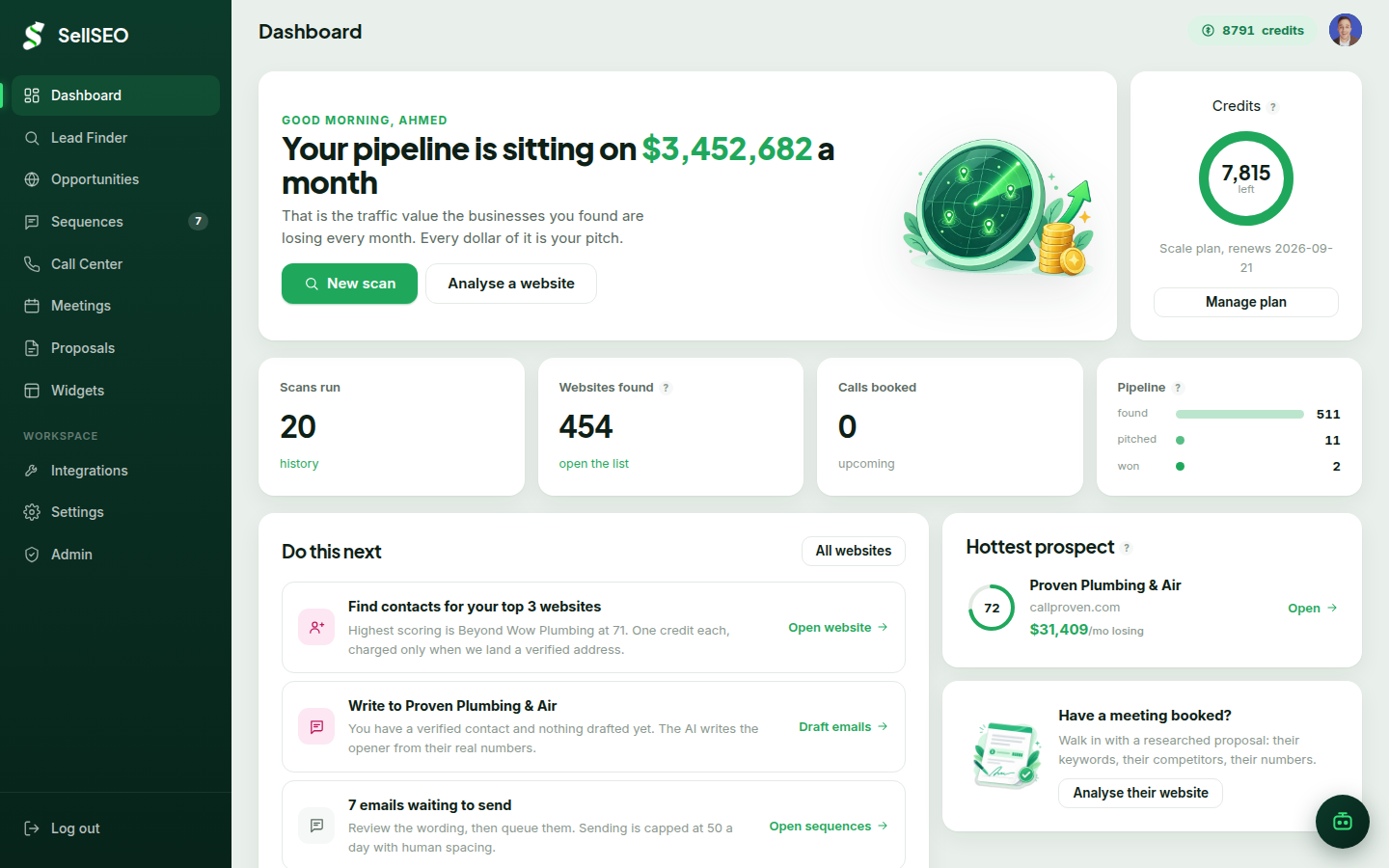
The dashboard keeps this honest: it surfaces the hottest prospect, the monthly traffic value your pipeline is sitting on, and a short list of what to actually do next.
Step 5: Open with the evidence
Once you have found contacts for the businesses worth writing to, the opener writes itself, because you are not making a claim. You are reporting a number they can check: the phrase, the volume, the position they hold, the position their competitor holds, and what the difference is worth per month.
Nobody argues with a measurement. They either did not know, or they knew and nobody had put a figure on it. Both of those are a conversation.
The short version
- One niche, one city. Never a whole country.
- Let the scan read demand, rankings, ad spend and AI answers, not just addresses.
- Read the signal sentence, not only the score.
- Work the top three or four properly.
- Open with a number they can verify themselves.
That is the whole method. The work is in doing it consistently, one market at a time.