SellSEO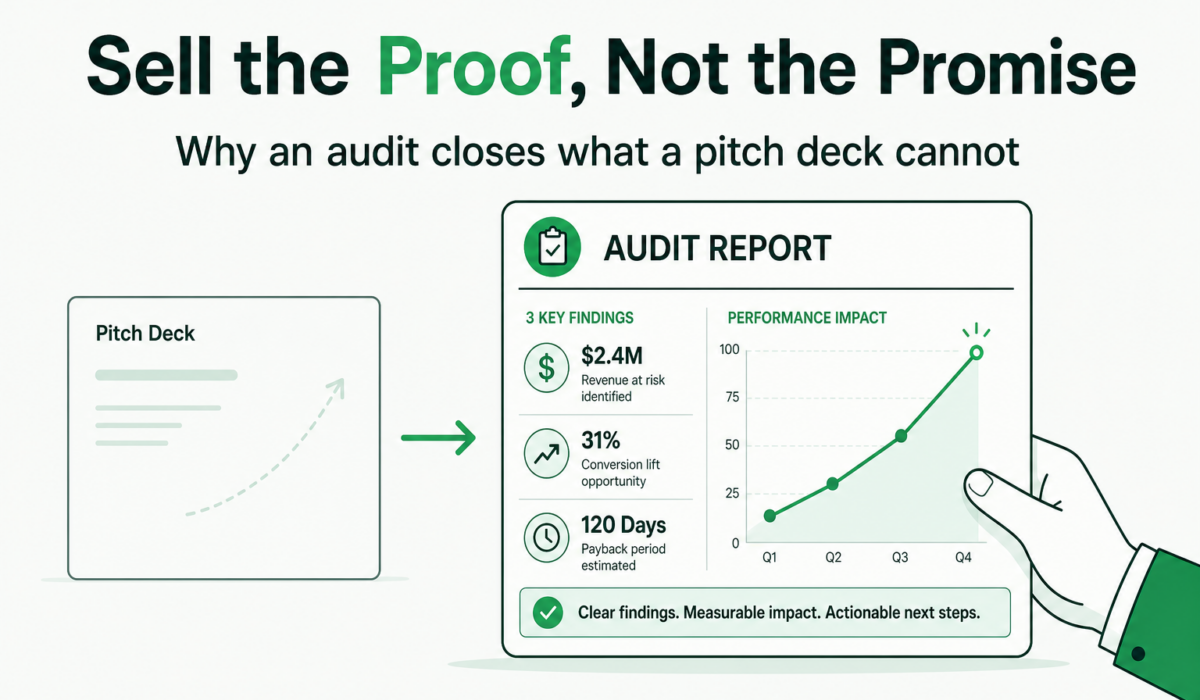
 SellSEO
Most agencies lose the deal before the call ends, and they lose it for a reason that has nothing to do with how good they are at SEO. They spend the meeting describing what they would do. The prospect spends the meeting deciding whether to believe them. Those are two different activities, and only one of them closes.
The fix is not a better script. It is a different order of operations: show the prospect something true about their own website before you ask them for anything. This piece is about why that works, what the research says, and how to run it without spending three unpaid hours on every lead.
Buyers are not shopping for services. They are shopping for a reason to trust you
Clutch and Ignite Visibility surveyed more than 300 marketing decision makers about how they choose SEO partners, and a separate survey of 1,200 business owners looked at the same question from the small business side. The results are consistent and, if you sell SEO, a little uncomfortable.
Start with discovery. Around 52% of businesses find SEO companies through referrals. That is the front door. But the moment you look at what decides the purchase, referrals slip down the list. Buyers rank services offered at 55%, referrals at 49% and price at 46%. And the factor that outranks all three: 74% of business owners call an SEO provider’s reputation “very” or “extremely” important.
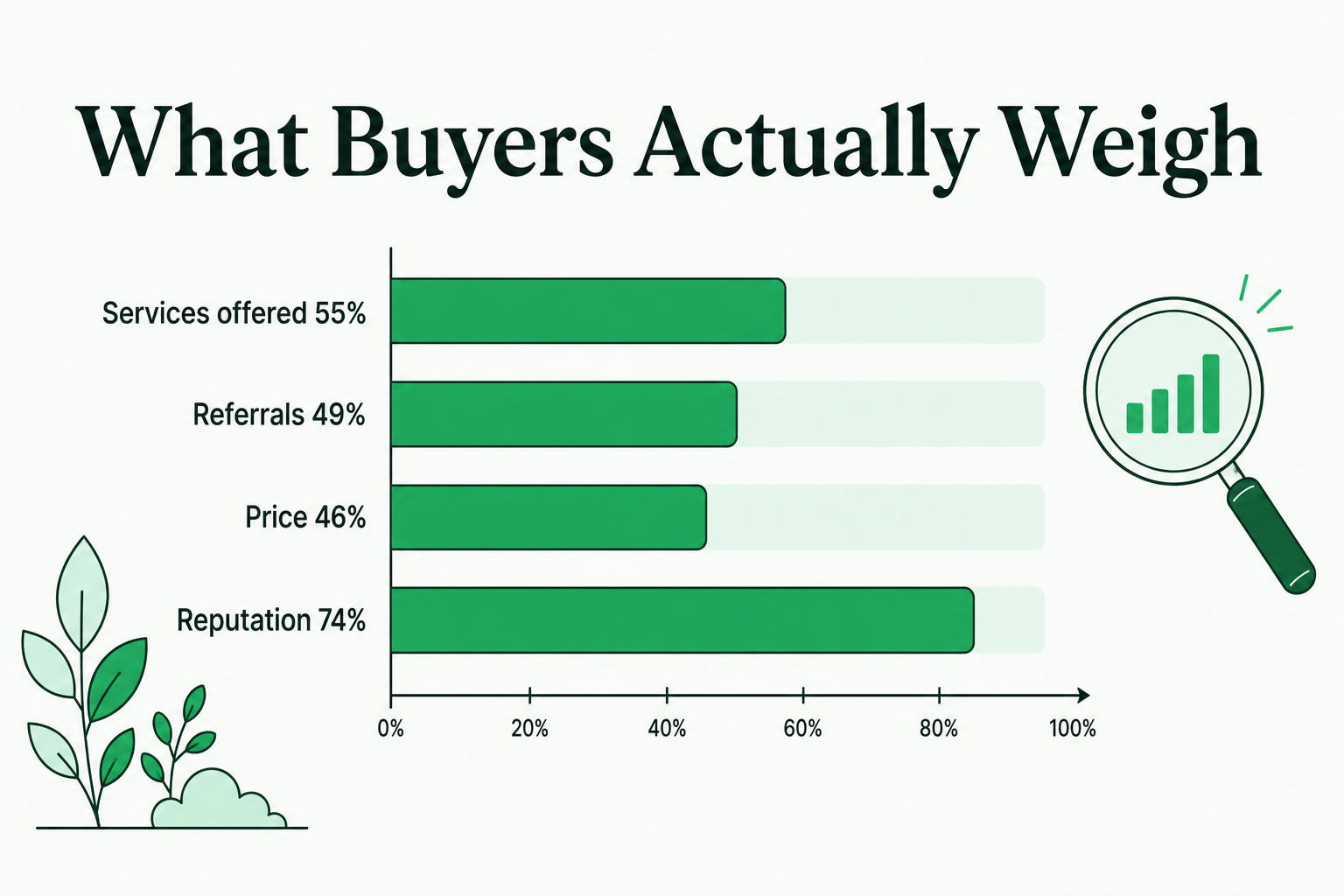
Read those numbers together and a picture forms. A referral gets you in the room. Reputation gets you the contract. Price is the least decisive of the four, which should be liberating news for anyone who keeps discounting to win work.
Then there is the reason they are hiring at all: 61% of businesses bring in an SEO agency because they lack the in-house expertise to do it themselves. They are not buying tactics. They cannot evaluate your tactics. They are buying relief from a problem they know they have and cannot see clearly.
That last point is the whole game. If your prospect cannot evaluate your technical skill, then everything you say about your technical skill is noise. What they can evaluate is whether you understood their situation faster and more precisely than anyone else who called them this month.
The pitch deck problem
Here is the number that should change how you build proposals. Proposals assembled from rigid templates win somewhere between 15% and 25% of the time. Proposals genuinely customised to the prospect win between 50% and 65%.
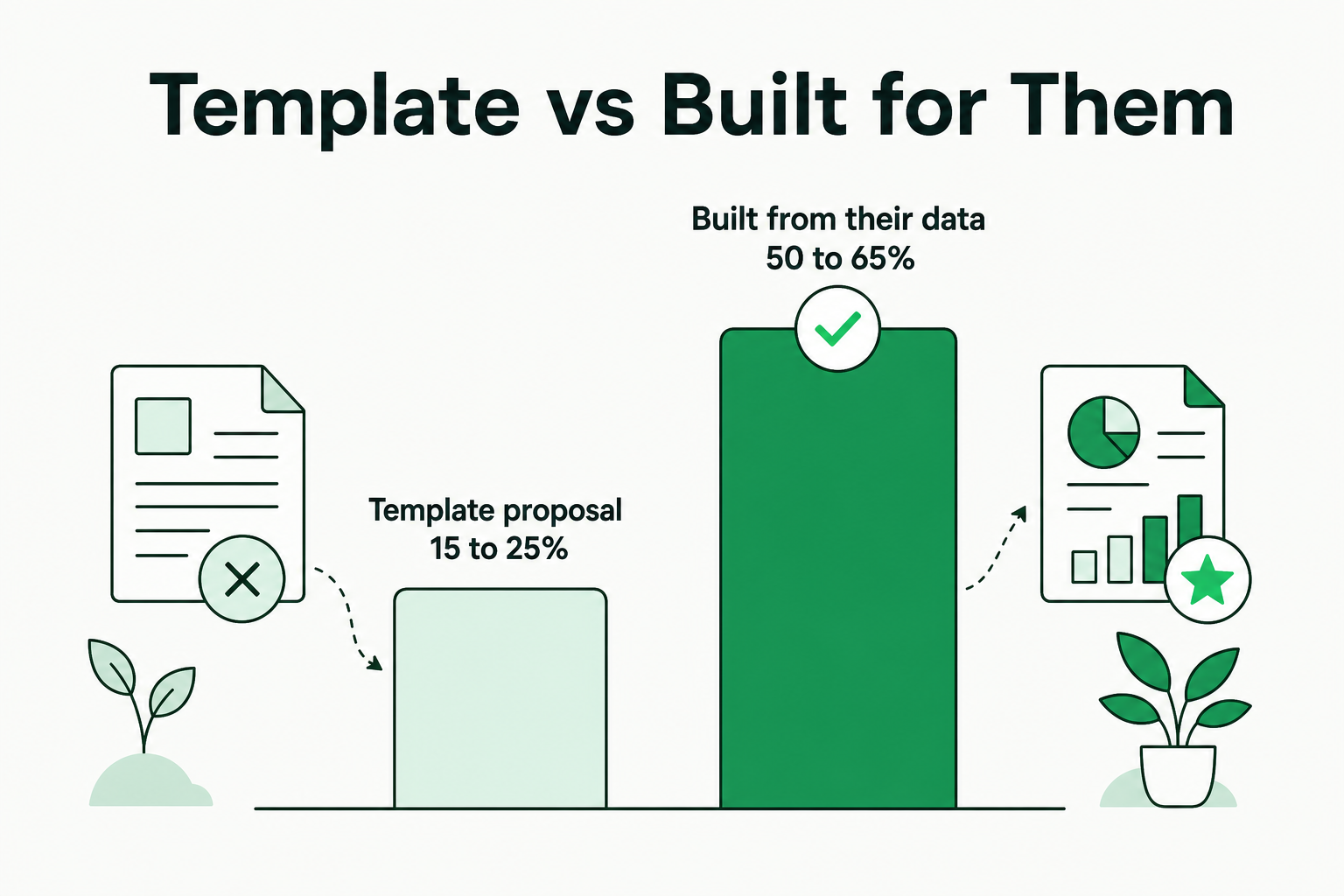
That is not a marginal improvement. That is the difference between a business that closes one in five and a business that closes one in two. Same service, same price, same person delivering it. The variable is whether the document in front of the buyer is about them or about you.
Most agency proposals fail this test in the first thirty seconds. They open with a company history, a client logo wall and a description of the SEO process in general terms. The buyer has seen four of these this quarter. They all say the same thing, because at that level of abstraction there is only one thing to say.
A proposal built from the prospect’s own data cannot be confused with a competitor’s, because it contains facts that apply to exactly one company on earth.
What proof actually means
“Show proof” gets repeated so often that it has stopped meaning anything. It does not mean case studies. Case studies are proof that you helped somebody else, which is useful, but it is second hand and every agency has them.
Proof, in the sense that closes deals, is a specific, checkable, uncomfortable fact about the prospect’s own business that they did not know this morning. It has three properties.
It is specific. Not “your site has technical issues” but “your service pages take 4.8 seconds to become interactive on mobile, and your three closest competitors are all under 2.5 seconds.”
It is verifiable. The prospect can check it themselves in five minutes. This matters enormously. A claim they can verify converts scepticism into trust in a single step. A claim they cannot verify just sits there asking to be believed, and belief is exactly what they are short of.
It has a number attached to what it costs. “You rank eleventh for a term with 2,400 monthly searches in your city” is interesting. “You rank eleventh for a term with 2,400 monthly searches, the first position takes roughly a quarter of those clicks, and at your stated job value that gap is worth about 9,000 dollars a month” is a business problem with a price tag.
The third property is where most audits stop short. Technical findings without a revenue translation are a list of chores. The owner does not care that a meta description is missing. They care that a competitor is eating a meal that was supposed to be theirs.
The proof-first sequence
Here is the order that works, and the order matters more than any individual piece of it.
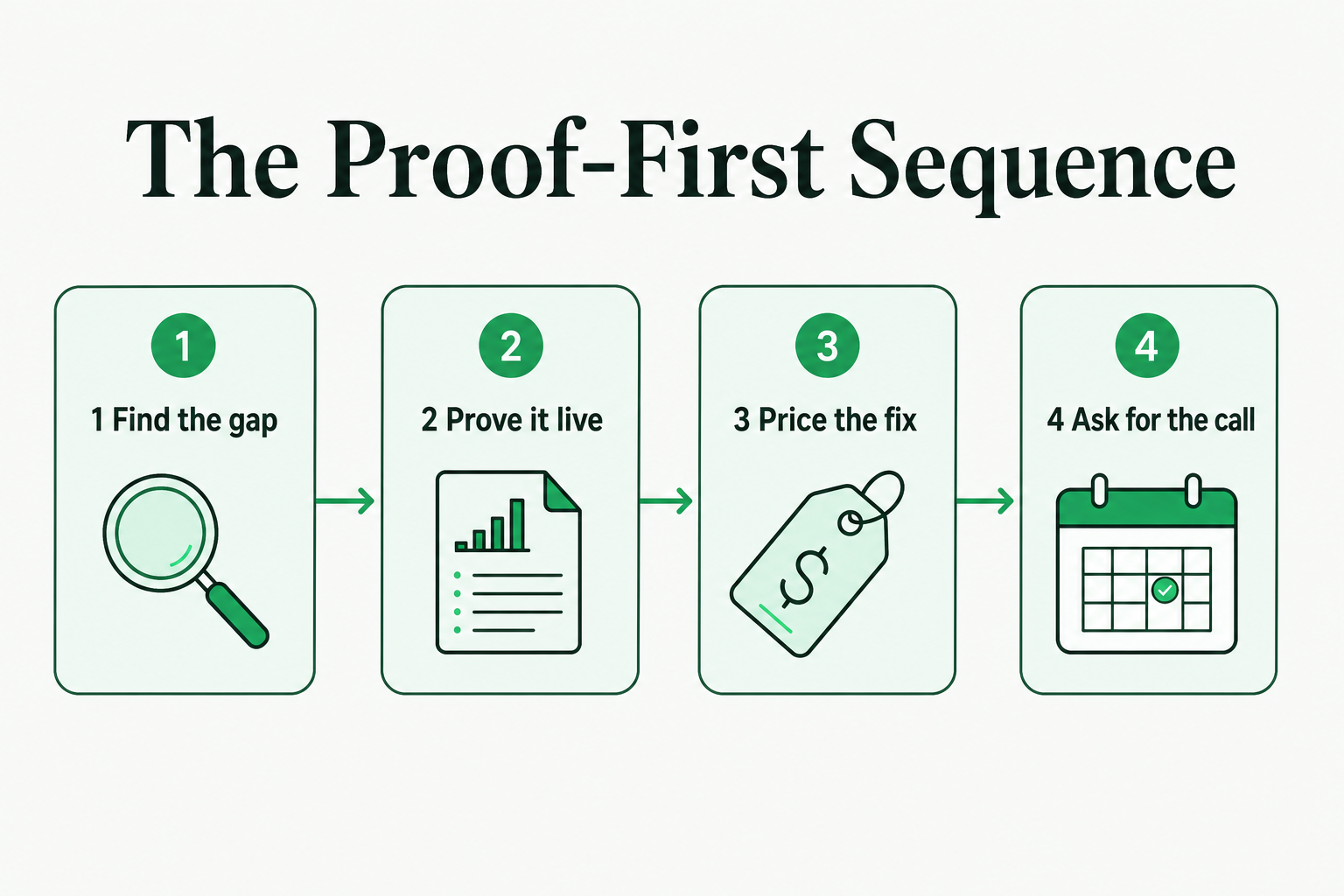
1. Find the gap before you make contact
Do the work first. Not a full audit, which is not economical at the top of the funnel, but enough to find one real, defensible gap: a keyword where they sit on page two while a direct competitor holds the top, a technical fault that is measurably costing them, an absence from AI assistants when someone asks for the best provider in their city.
One gap is enough. The goal at this stage is not completeness. It is credibility. Completeness is what you sell them later.
2. Prove it live, not in an attachment
Attachments do not get opened. A link to a page built for them does. The page should carry the finding, the evidence behind it, and what it appears to be costing, and it should be readable in under two minutes.
The reason a live page beats a PDF is not aesthetic. It is that you can see whether they opened it, how long they stayed and what they clicked. That is intent data you cannot get any other way, and it tells you which follow-up is worth your time and which prospect has gone cold.
3. Price the fix, not the service
The proposal should answer the question the proof raised. If you told them they are losing an estimated 9,000 dollars a month to three keywords, the proposal is about closing that specific gap, and your fee sits next to that number rather than next to the fee of the agency they spoke to last week.
This is the quiet advantage of proof-first selling. It moves the comparison from “your price against their price” to “your price against the cost of doing nothing.” Only one of those comparisons can be won on merit.
4. Ask for a small, specific next step
Not “let me know your thoughts.” A named time, a short call, one decision. Vague closes are how deals go quiet, and a deal that goes quiet is rarely revived by a fifth email that also ends in “let me know.”
What to say, concretely
The opening message is where most of this gets thrown away. Here is the shape that works, and why each part is there.
Your site ranks 11th for [term], and [competitor] is first. That one gap is worth roughly [number] a month at your average job value. I put the numbers on one page here: [link]. If it looks wrong, tell me and I will correct it. If it looks right, I can walk you through the three fixes on a 15 minute call Thursday.
Four things are happening there. It opens with a fact about them, not a greeting about you. It converts the fact into money. It invites correction, which signals confidence and lowers the buyer’s defences. And it closes with a specific, small ask.
The invitation to correct you is the underrated part. Prospects expect to be sold to, so they arrive braced. An agency that says “tell me if I got this wrong” is doing something the last four did not, and it costs you nothing, because if your data is right they cannot correct it anyway.
When they push back on your number
Sooner or later a prospect will tell you the estimate is wrong. This is the moment proof-first selling either pays off or falls apart, and most people handle it badly by defending the figure.
Do not defend it. Agree quickly and ask for the correction: “Fair enough, what is your actual average job value?” Then recalculate in front of them.
Two useful things happen. First, whatever number they give you is now their number, and people do not argue with their own arithmetic. Second, you have just been handed the single most important qualifying fact in the conversation without asking for it directly, which is what an average job is worth to them. A business where a job is worth 400 dollars and one where a job is worth 40,000 dollars are not the same prospect, and they should not get the same proposal.
The related objection, and the more common one, is “we tried SEO before and it did not work.” Treat this as information rather than resistance. Ask what was delivered, over how many months, and what was reported. Nine times in ten the answer describes activity rather than outcomes: blog posts published, directories submitted, a monthly PDF nobody read.
That answer is a gift. It tells you exactly what the buyer is afraid of, which is paying for motion again instead of results. Your proposal can then be built to remove that specific fear: fewer deliverables, named outcomes, and a reporting line the owner can check without asking you. A prospect burned once is not a harder sale. They are a better qualified one, because they have already accepted that the problem is real and worth money.
Doing this at volume without drowning
The obvious objection: this is fine for ten prospects a month and impossible for two hundred. That objection is correct if you do it by hand. Most agencies that try proof-first selling abandon it within a month, because a manual audit takes two to three hours and the arithmetic stops working almost immediately.
The way through is to separate the parts that must be human from the parts that do not.
Finding the gap is data work. Pulling rankings, comparing against local competitors, checking whether the site is technically sound, checking whether AI assistants mention the business at all: every part of that can be gathered automatically. Turning the result into a page a business owner can read is templating, and templating is a solved problem.
What must stay human is the judgement about which gap to lead with, and the conversation once they reply. That is roughly fifteen minutes per genuine prospect rather than three hours.
The practical rule: automate everything up to the point of contact, and be entirely human after it. Agencies that automate the conversation itself get the worst of both worlds, because a prospect who realises they are talking to a template has just learned something about your attention to detail that no proposal will undo.
Know which numbers to watch
Once you sell this way, the metric that matters shifts. Most agencies track leads. Proof-first selling makes win rate by source the number worth staring at, because the same pitch performs very differently depending on where the prospect came from.
Published benchmarks for SEO and content services put cold outbound win rates at roughly 12% to 20%, warm and inbound leads at 35% to 55%, and competitive RFPs at 36% to 42%. For small agencies and freelancers overall, a proposal win rate between 25% and 40% is typical. Above 40% suggests you are qualifying well. Below 20% is usually a targeting, pricing or proposal quality problem rather than a closing problem, and no amount of closing technique will repair it.
There is a broader benchmark worth holding yourself to. Across B2B, the median proposal-to-close rate sits around 25%, with the top quartile above 35% and the bottom quartile below 18%. RAIN Group’s survey of 472 sellers and executives found that once a prospect reaches the proposal stage, a win rate near 47% is achievable.
If your proposal-to-close rate sits below 25%, the problem is almost never the proposal document. It is that proposals are going to people who were never going to buy. Proof-first selling fixes this from the front, because a prospect who reads a page about their own lost revenue and then books a call has already qualified themselves in a way no discovery form can match.
The one sentence version
Buyers cannot judge your SEO skill, so they judge your understanding of their situation instead. Reputation outranks price by a wide margin, custom proposals close at two to three times the rate of templates, and the fastest way to build both at once is to arrive already knowing something true and specific about their business.
Stop opening with what you do. Open with what you found.