SellSEO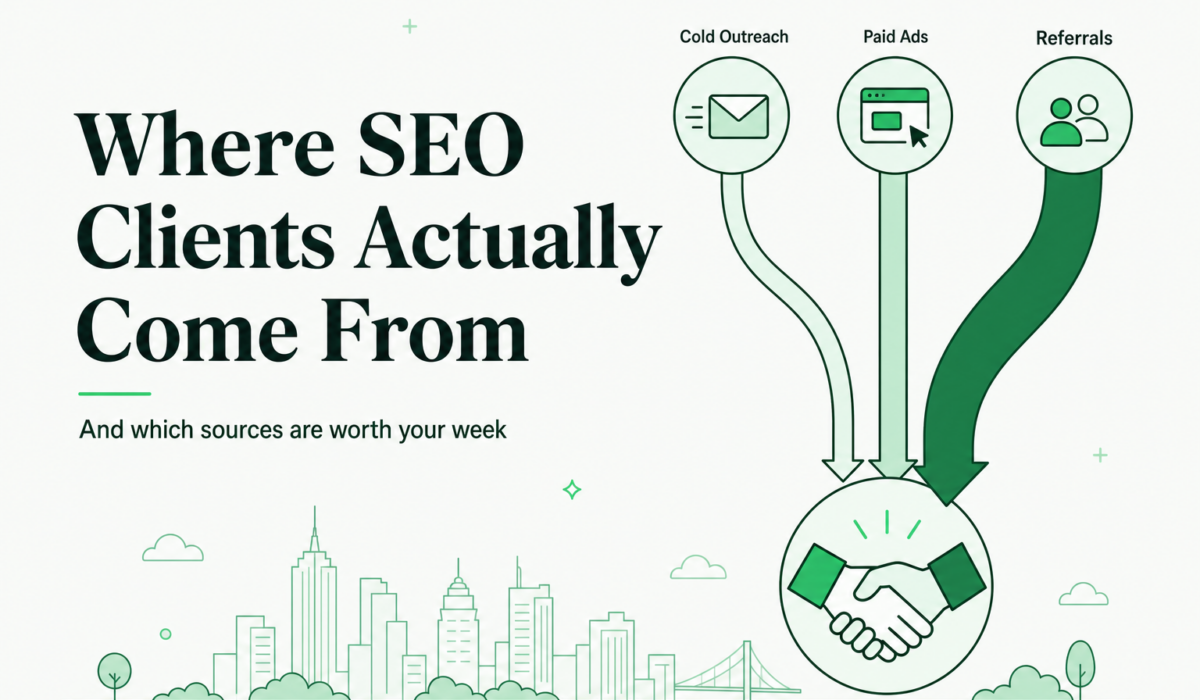
 SellSEO
Every agency owner has a version of the same week. Monday is spent on cold outreach. Tuesday on a LinkedIn post nobody engages with. Wednesday on a proposal for a lead that came from a referral six weeks ago and was always going to close. Thursday on a directory listing. Friday wondering which of those four things actually paid the bills.
The honest answer is that most agencies do not know, and the ones that do know are usually surprised. This article is about what the evidence says regarding where SEO clients come from, which sources convert, and how to build a pipeline that does not collapse the month you get busy.
Referrals are the front door
Around 52% of businesses find SEO companies through referrals. For small business owners specifically, the discovery routes are referrals, Google searches and online reviews, in roughly that order.
That figure surprises nobody who has run an agency. What is more interesting is what happens next, because discovery and decision are two separate stages and they do not rank the same factors.
When it comes to actually choosing, buyers weigh services offered at 55%, referrals at 49% and price at 46%. And sitting above all of them, 74% of business owners describe an SEO provider’s reputation as “very” or “extremely” important.
So a referral gets you considered. It does not get you hired. The prospect still goes and looks you up, and what they find at that point decides the deal. Which means the referral and the reputation are two different investments, and most agencies make only the first.
The win rates that should shape your week
Here is the number that should determine how you spend your time. Win rates for SEO and content services vary enormously by where the lead came from.
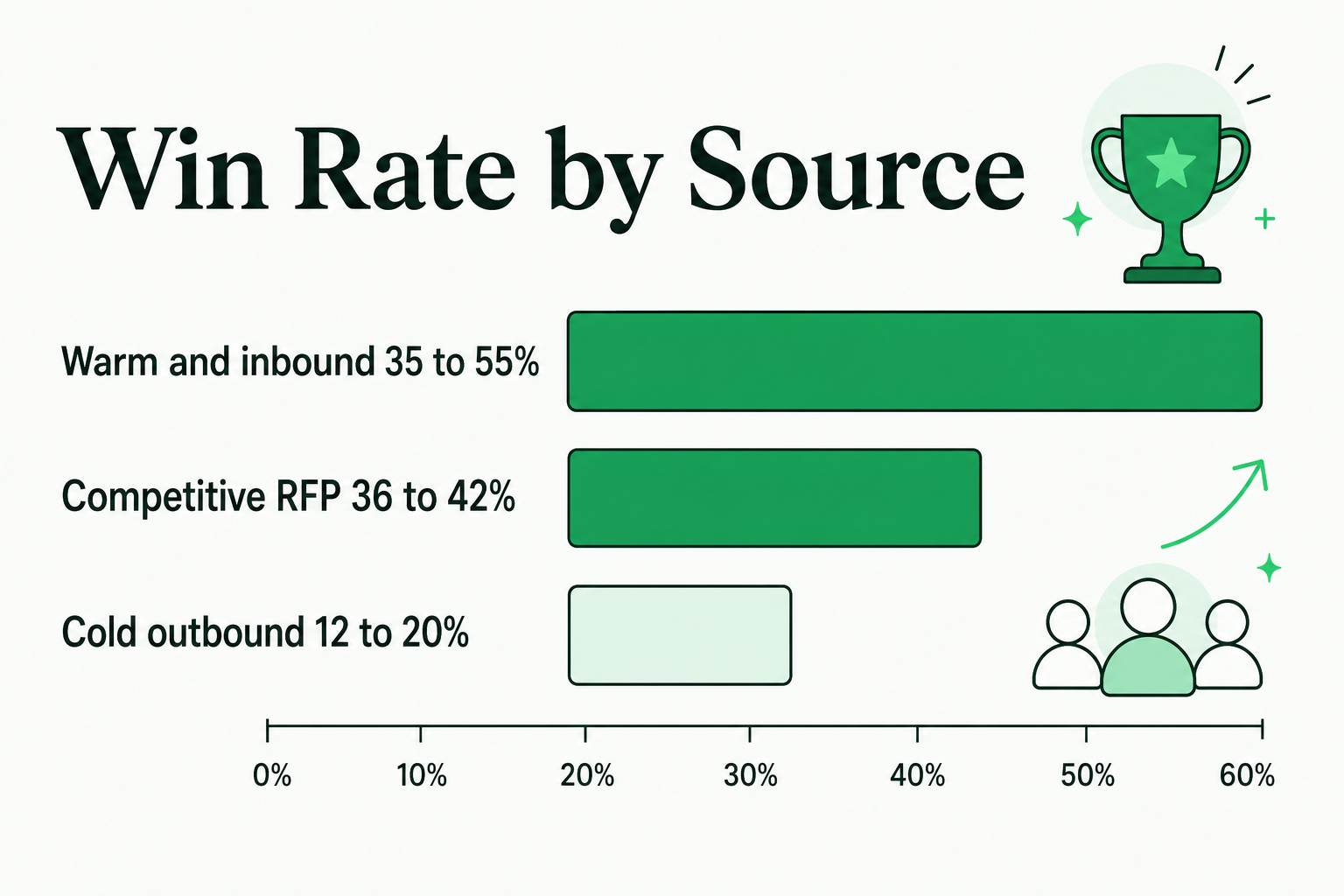
Cold outbound converts at roughly 12% to 20%. Warm and inbound leads convert at 35% to 55%. Competitive RFPs sit at 36% to 42%.
Warm leads close at somewhere between two and three times the rate of cold ones. That is the whole argument for investing in the sources that produce warm leads, and it is also the argument against abandoning cold outbound entirely, because 12% to 20% of a large number is still a business.
The mistake is treating these as competing strategies. They are different instruments with different time signatures. Outbound produces leads this month at a low conversion rate. Referrals and reputation produce leads at a high conversion rate, but only after months of work you cannot shortcut. An agency that only does outbound never builds the compounding asset. An agency that only waits for referrals has no control over its own pipeline.
Making referrals a system rather than a hope
Most agencies “do referrals” in the sense that they are grateful when one arrives. That is not a channel, it is luck with good manners.
Three things turn it into something you can count on.
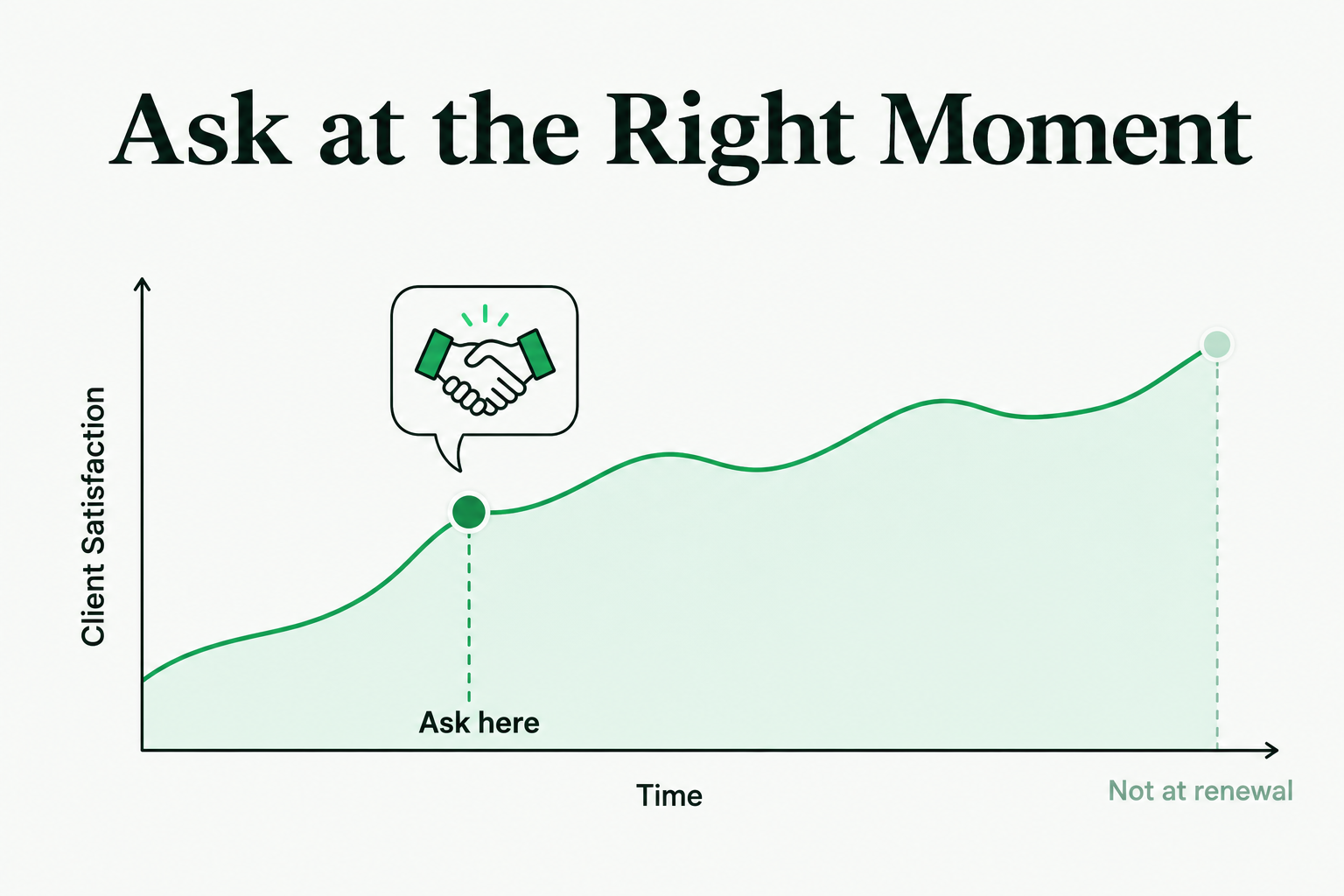
Ask at the moment of the win, not at renewal. The instinct is to ask when the contract is up, which is precisely the moment the client is evaluating whether to keep paying you. Ask instead on the day something good happens: the ranking that moved, the month enquiries jumped, the competitor you overtook.
Ask for something specific. “Do you know anyone who needs SEO” produces nothing, because it asks the client to search their entire memory with no filter. “You mentioned your supplier in Hamilton is in the same position you were in six months ago. Would you introduce me?” produces an introduction, because you have done the thinking for them.
Make the introduction easy to forward. Write the message they can paste. Two sentences, no attachments, no pitch. Every extra step you leave for the referrer is a chance for the whole thing to die in a drafts folder.
One more thing worth saying plainly: 90% of online customers trust recommendations from peers. That is why a referral outperforms every message you could write yourself, and why protecting your reputation with existing clients is a sales activity, not just a delivery one.
Your own rankings are a sales asset
Buyers told researchers that a provider’s own Google rankings influenced their decision, alongside reputation and cost. This is uncomfortable for a large number of SEO agencies, because they rank for nothing.
The excuse is familiar and half true: we are too busy doing client work. The problem is that the prospect cannot see your client work. They can see your site. An agency invisible in search asking a business to pay for search visibility has a credibility gap it has to talk its way out of, at exactly the moment it can least afford one.
You do not need to rank for “SEO agency,” a term dominated by firms with a decade of authority and budgets you do not have. Rank for what your actual buyers type: the intersection of your service, their industry and your city. Fewer searches, far better intent, and reachable in months rather than years.
And treat the ranking as a sales asset rather than a traffic source. Being findable for “SEO for dentists in Calgary” matters less for the visits it produces than for what happens when a referred prospect searches your name and finds you occupying the exact space you claim to specialise in.
Reviews do quiet work
Online reviews are one of the three main discovery routes for small business owners, and they are the cheapest reputation asset available.
The pattern that helps: a modest number of detailed, specific, recent reviews beats a large number of old generic ones. A review that says “took our enquiries from four a month to nineteen over eight months” does more than fifty saying “great to work with,” because the first one is checkable and the second could have been written about anyone.
Ask for reviews at the same moment you ask for referrals, and ask the client to mention what actually changed. Most people are willing and simply do not know what to write.
Where cold outbound still earns its place
At 12% to 20%, cold outbound is the least efficient channel by conversion and the most controllable by volume. That trade is worth making in two specific situations.
The first is when you are new, or entering a new city or vertical, and have no referral base to draw on. Outbound is the only channel that produces leads before you have a reputation, and every agency has to survive that period somehow.
The second is when you can make cold contact substantially warmer than it usually is. The 12% to 20% figure describes generic outbound. A first message carrying a specific, verifiable finding about the recipient’s own site is a different instrument, because the recipient has learned something before deciding whether to reply.
That is the practical bridge between this article and the first one in this series. Proof-first outreach does not turn cold into warm, but it moves it meaningfully along that line, and at scale a few points of conversion is the difference between a channel that works and one that quietly loses money.
Partnerships are referrals you do not have to wait for
A referral from a happy client arrives when it arrives. A referral partner produces them on a schedule, and this is the channel most agencies skip entirely because it feels slower than it is.
The people who already sell to your buyer and do not do what you do are the whole opportunity: web design studios, PPC agencies, brand and design shops, developers, PR firms, business coaches, accountants who serve one trade well. Every one of them regularly hears “can you also help with our Google rankings” and currently has nowhere good to send it.
What makes these work is being unmistakably specific about the boundary. A web designer who fears you will take over the client relationship refers nobody. A web designer who knows you do search and never touch design, and who has watched you send work back the other way, refers repeatedly. Send first, and send genuinely, before asking for anything.
Keep the commercial side simple and stated openly. Either a fixed introduction fee, or a share of the first few months, or a clean reciprocal arrangement with no money involved. Vagueness here is what kills partnerships after the second referral, when someone feels short changed and says nothing.
Five partners who each send one lead a quarter is twenty warm leads a year, at warm conversion rates, from relationships that cost you a coffee and the discipline to follow up.
Two channels not to bother with yet
Some advice worth giving in the negative, since both of these consume enormous time at small agencies and pay back slowly.
Paid directories that promise qualified leads mostly sell the same lead to four agencies simultaneously. You then compete on price with three firms who are also paying for the privilege, which is close to the definition of a bad market to be in. Free listings that improve your discoverability are worth the twenty minutes. Paid lead resale rarely is, until you have the volume to treat it as an experiment rather than a lifeline.
Broad social posting is the other. Publishing general SEO advice into a feed mostly reaches other SEO people, who are not your buyers. It can build a genuine audience over years, but it is a poor use of the hours of an agency that needs clients this quarter. If you are going to spend time writing, spend it on the specific thing your specific buyer searches for, where the intent is already there.
Neither of these is worthless. Both are the wrong thing to do first.
Track source honestly
The single highest-return administrative habit in an agency is recording, for every closed deal, where it actually came from, and being strict about it.
Strict matters. A lead that arrived through a referral, then read three of your articles, then searched your name, is a referral. The blog did not create it, though it may well have saved it. Agencies that credit the last touch systematically overvalue whatever sits closest to the sale.
Then compare two things per channel: what proportion of deals it produced, and what proportion of your working hours it consumed. The gap between those two numbers is where most agency time is wasted. The common finding is that outbound eats sixty percent of the week and produces twenty percent of the revenue, while referrals produce half the revenue on almost no time at all, and nobody has ever spent a scheduled hour on them.
That does not mean stopping outbound. It means noticing that the highest-converting channel in your business has no owner, no process and no calendar slot.
The short version
Half of SEO buyers arrive through referrals, but the decision turns on reputation, which 74% call very or extremely important. Warm leads close at two to three times the rate of cold ones, so the work that makes leads arrive warm compounds in a way outbound never does.
Ask for referrals at the moment of a win rather than at renewal, and ask for a named person rather than anyone at all. Rank for the specific thing you sell in the specific place you sell it, because prospects check. Collect reviews that contain numbers. Keep outbound running, but make it carry proof so it converts closer to the top of its range than the bottom.
And write down where every deal came from. Most agencies are guessing, and most are guessing wrong in the same direction.
One closing thought about sequencing, because the order you build these in matters as much as the list itself. Outbound first, because it is the only channel that works before anyone has heard of you and it keeps the lights on while everything else matures. Reputation second, meaning your own rankings, your reviews and the case studies you are entitled to publish. Referrals and partnerships third, once you have clients happy enough to vouch for you and results concrete enough to be worth vouching for.
Agencies get into trouble when they try to start at the third step, or when they are still living entirely on the first one three years in. The first is impatience and the second is a business with no compounding asset, which is a much more expensive mistake because it only becomes obvious when outbound stops working.