SellSEO
 SellSEO
There is a version of the SEO sales call that almost every agency runs, and it goes like this. Fifteen minutes of the prospect explaining their business. Then twenty five minutes of the agency explaining SEO. Then a promise to send a proposal. Then silence.
The call felt fine. Everyone was polite. And the deal was lost somewhere around minute eighteen, when the conversation stopped being about them.
We now have unusually good data on what separates the calls that close from the calls that do not, because conversation intelligence platforms record and analyse them at a scale no individual seller could. This piece works through what that data actually says, and what it means for anyone selling SEO.
The dataset
Gong’s 2025 analysis covered 326,000 sales calls, comparing the ones that ended in closed won against the ones that ended in closed lost. It is worth being precise about what that kind of study can and cannot tell you. It shows correlation across a very large sample. It does not prove that copying the behaviour causes the outcome, and some of what it measures is a symptom of a good conversation rather than the cause of one.
With that caveat in place, the patterns are consistent enough to be worth acting on, and two of them contradict what most sales training teaches.
Winners ask fewer questions
Sellers who won asked 15 to 16 questions across the call. Sellers who lost asked about 20.
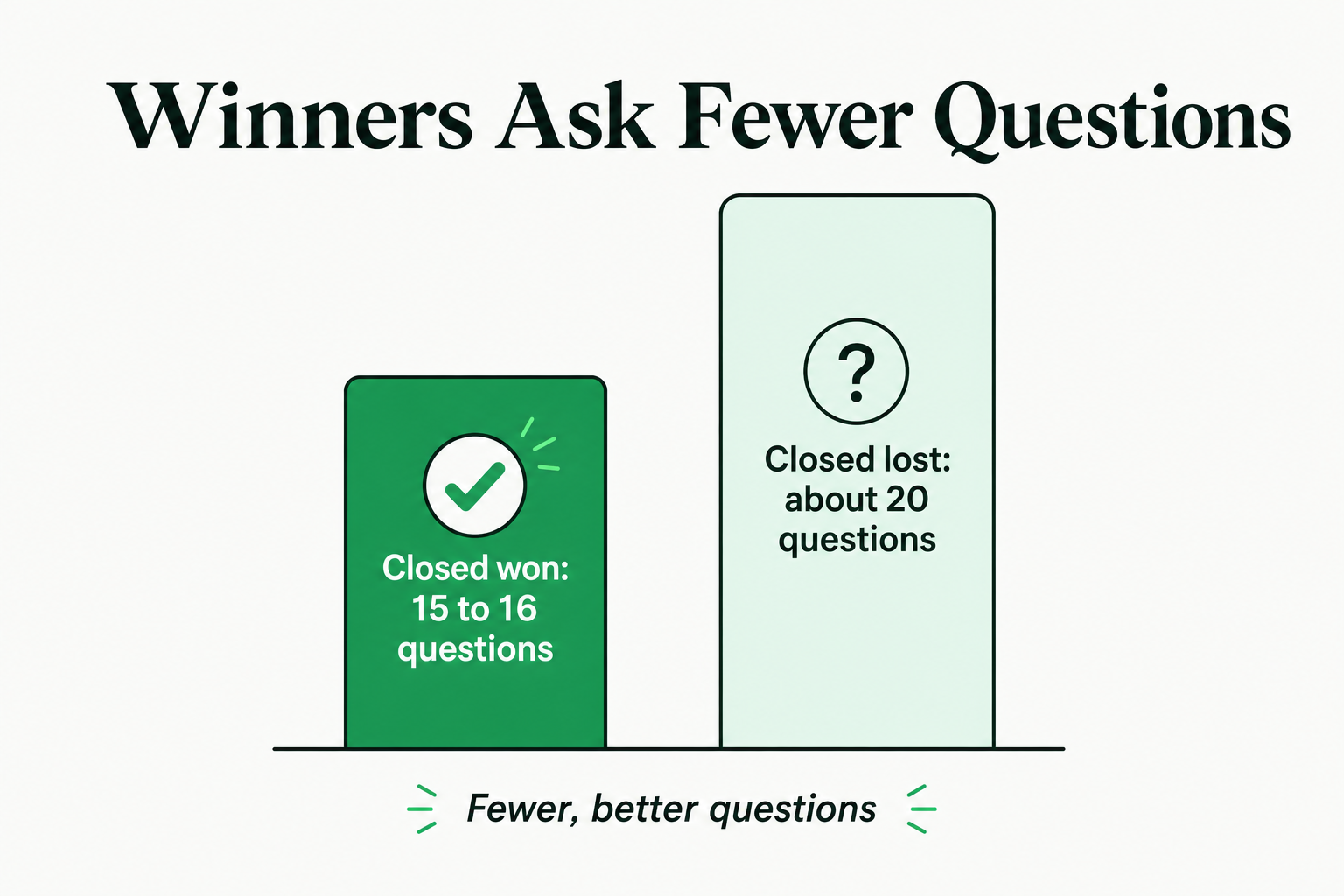
This runs directly against the advice most people have absorbed, which is that discovery means asking a lot of questions. The data says the opposite: more questions correlates with losing.
The explanation is not that curiosity is bad. It is that question count is a proxy for two very different activities. A seller who asks sixteen questions and goes deep on the answers is having a conversation. A seller who asks twenty is usually working through a checklist, and a checklist is audible. The prospect can hear that the next question was coming regardless of what they just said.
There is a second, less flattering explanation. High question counts often mean the seller never found the real problem, so they kept fishing. Twenty questions is what running out of ideas sounds like.
For SEO specifically, this matters more than in most categories, because the temptation to interrogate is enormous. You could ask about their CMS, their hosting, their previous agency, their content calendar, their backlink profile, their internal team, their reporting preferences. All of it is relevant to delivery. Almost none of it is relevant to the decision they are making on this call.
The talk time gap is smaller than the folklore
The widely repeated benchmark is a 43:57 talk to listen ratio, meaning the seller should talk 43% of the time. That figure comes from Gong Labs research published nearly a decade ago, and it has hardened into a rule that gets quoted as though it were physics.
The 2025 numbers are less dramatic. Deals that closed sat around 57% rep talk time. Deals that were lost sat around 62%.
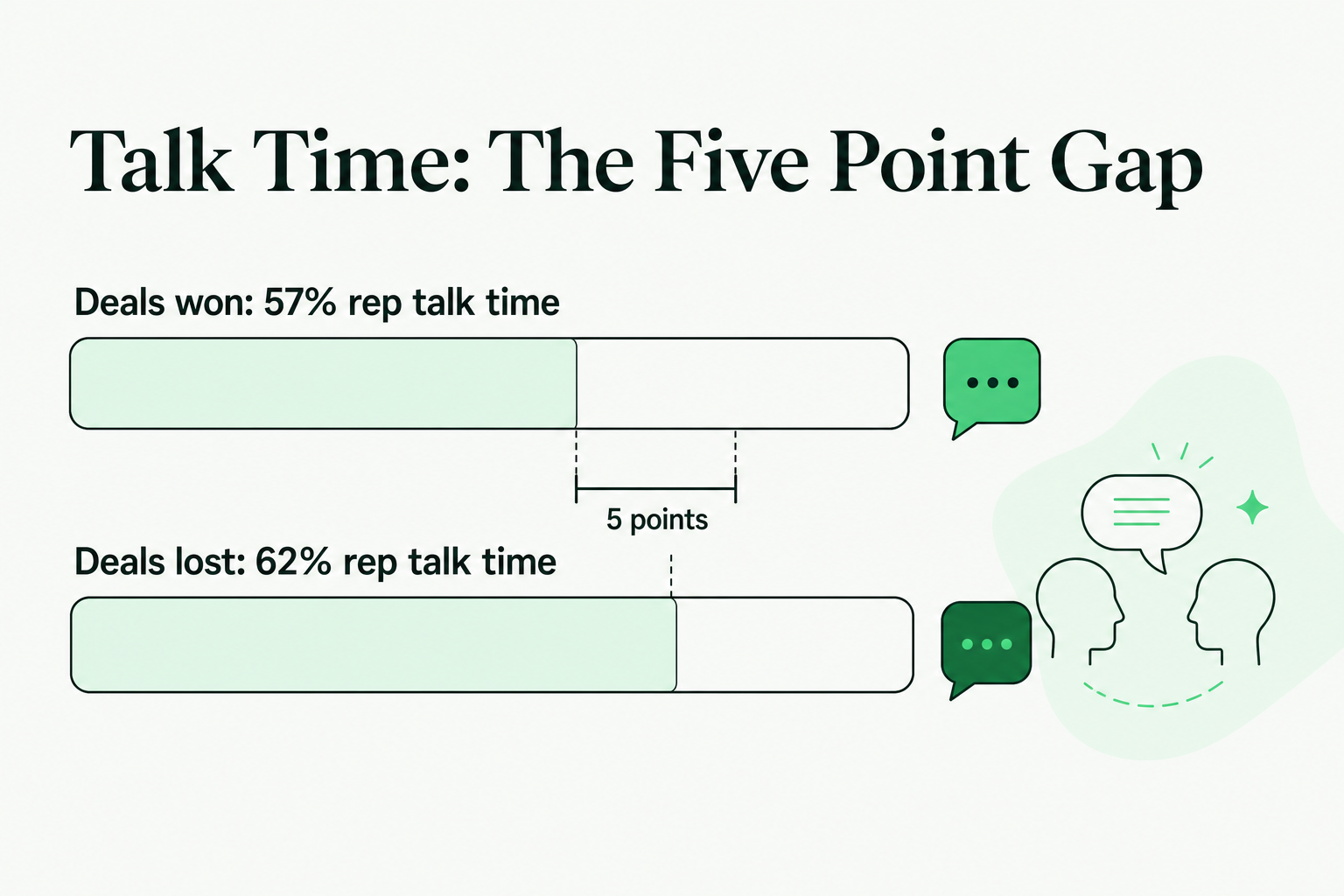
Five percentage points. That is the entire gap between a winning call and a losing one, and it is nowhere near 43%. Anyone who has been coached to talk less than half the time has been chasing a number that the current data does not support.
What the research found to matter more was consistency. Low performers swung wildly: 54% talk time on the calls they won, 64% on the calls they lost. High performers stayed flat across both.
That finding is more useful than the ratio itself, because it describes a mechanism. The low performer is not choosing to talk more on losing calls. They are reacting. When the prospect goes quiet or sceptical, they fill the silence, and filling silence with more explanation is the single most reliable way to talk yourself out of a deal. The high performer holds the same shape whether the call is going well or badly.
The practical version: do not aim for a ratio. Aim to behave identically when the call gets uncomfortable. The discipline is in the difficult moments, not in the average.
Why SEO calls go wrong specifically
SEO has a structural problem that most services do not. The buyer usually cannot evaluate the answer to their own questions.
When a prospect asks “what is your link building approach,” they are not able to assess whether your answer is good. They are checking whether you sound like someone who knows what they are doing. If you respond with fifteen minutes of technical detail, you have answered a question they did not really ask, and you have spent your talk time budget on material they cannot use.
The better move is to answer briefly and return the floor: “We earn links through digital PR and by making a few pages genuinely worth citing. I can go deeper on that if it is useful. Can I ask what prompted the question? Did a previous agency do something that worried you?”
That last sentence is doing the real work. Nine times out of ten there is a story behind a technical question, and the story is worth more than the answer.
The five questions that actually qualify
If the data says sixteen questions beats twenty, the useful exercise is deciding which ones earn their place. Here are five that do the heaviest lifting on an SEO call.
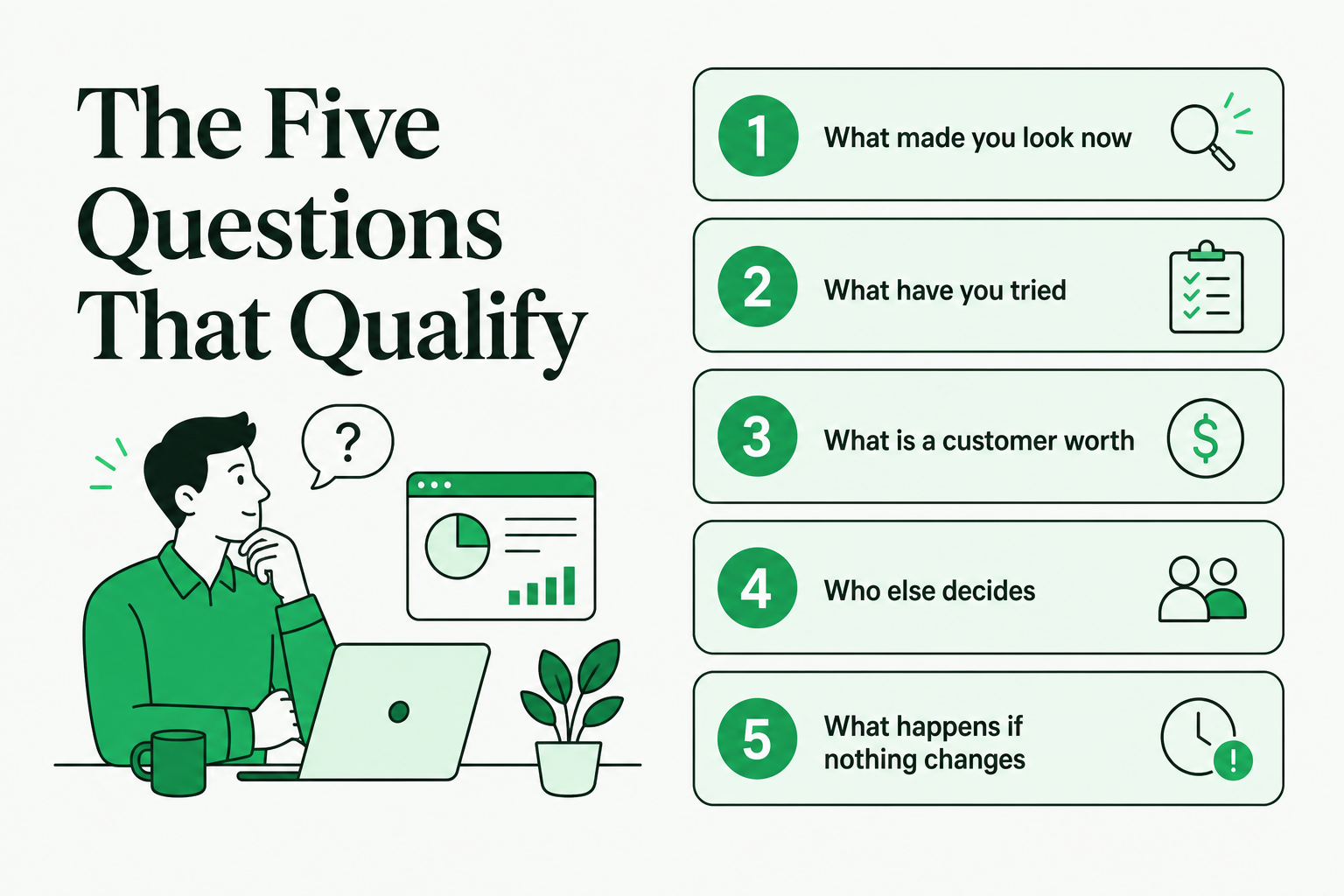
1. What made you look at this now?
Not “why are you interested in SEO.” The word “now” is the whole question. Every buyer has a trigger: a competitor overtook them, traffic fell, a funding round set new targets, an agency contract ended badly. Without a trigger there is no urgency, and without urgency there is no close, only a pleasant conversation that ends in “let us revisit next quarter.”
2. What have you already tried?
This is the highest yield question on the list. It tells you what has already failed, which competitors you are implicitly being compared against, and what vocabulary the prospect uses for disappointment.
Listen especially for the shape of the answer. “We published two blog posts a week for a year and nothing happened” tells you the previous provider sold activity rather than outcomes, and that your proposal needs to lead with outcomes and name them explicitly.
3. What is a customer worth to you?
Ask it plainly. Average job value, or lifetime value if they think that way.
Everything downstream depends on this number. It decides whether your fee is obviously reasonable or obviously absurd. A business where a customer is worth 300 dollars and one where a customer is worth 30,000 dollars require completely different proposals, and getting this wrong is the most common reason a good pitch lands badly on price.
It is also the number that turns your findings into an argument. “You are missing roughly 40 clicks a month on these terms” is a statistic. Multiplied by their conversion rate and their customer value, it becomes a number they feel.
4. Who else needs to be comfortable with this?
Phrased that way rather than “who is the decision maker,” which makes people defensive and often produces a slightly false answer. Nobody enjoys admitting they cannot decide alone.
“Who else needs to be comfortable” invites them to name a partner, a finance person, a board, without any loss of face. And you need those names, because a proposal written for the person on the call and forwarded to someone who was not on it fails silently.
5. If nothing changes, what does that cost you over the next year?
The most uncomfortable question, and the one that most sellers skip.
It asks the prospect to say the cost of inaction out loud, in their own words. That matters, because when they say it, it is their conclusion. When you say it, it is a sales tactic. The same sentence carries completely different weight depending on whose mouth it comes out of.
The structure that holds it together
Five questions is not a script, and reading them in order produces exactly the checklist effect the data warns against. What follows is a shape, not a sequence.
Open with your finding, not with rapport. If you have done proof-first work, you already know something specific about their site. Lead with it inside the first two minutes. It changes the entire frame of the call from a vendor pitch to a working session, and it earns you the right to ask the harder questions later.
Spend the middle on consequences, not features. The questions above are all consequence questions. None of them are about SEO. That is deliberate: you are establishing the size of the problem before anyone discusses the price of the solution.
Handle the price question by answering it. When they ask what it costs, tell them. Deflecting with “it depends on scope” reads as evasion and is the fastest way to lose credibility built over twenty minutes. Give a range, name what moves a project to the top or bottom of it, and move on.
Close on a specific next step with a date on it. Not “I will send a proposal.” Rather: “I will send the plan Tuesday. Can we hold twenty minutes Thursday to go through it, so you are not reading it cold?” A scheduled review beats an emailed document, because documents sent into silence stay silent.
The two questions that end most SEO calls
Two questions arrive on nearly every call, usually late, usually from someone who has been quiet until then. Both are traps, and both are survivable if you answer them honestly rather than smoothly.
“How long until we see results?” The wrong answer is a confident short number, because you will be held to it and you will miss. The other wrong answer is “it depends,” which sounds like you do not know.
Answer with a staged shape instead. Say what moves in the first six to eight weeks, which is usually technical fixes and pages that were nearly ranking crossing over. Say what moves at three to six months, which is the terms that actually matter. Then name the specific thing that would make it slower for them, whether that is a thin backlink profile, a site migration in their past, or a competitor with a decade of authority. Naming the risk yourself is what makes the timeline credible.
“Can you guarantee we will rank number one?” The answer is no, and saying no clearly is worth more than the deal you think you are protecting by fudging it.
What you can guarantee is the work, the reporting, and the terms you are targeting. Say that. Then add the sentence that reframes the question: “Anyone who guarantees position one is either not doing the work or not telling you the truth, because none of us control the ranking algorithm. What I will commit to is what gets done, what gets measured, and that you can check it yourself.”
Prospects ask for guarantees because they have been burned or because they are nervous, not because they expect one. A straight no, delivered without defensiveness, is frequently the moment the call turns in your favour.
What to do after the call
One habit separates agencies that improve from agencies that repeat the same call for years: record and review them.
The research is clear that systematic call review works, with reported close rate lifts in the 20% to 30% range when it is done consistently. You do not need an enterprise platform for this. A recorded call and twenty minutes of honest listening will find the problem.
Listen for three specific things. Where did you start talking and not stop? What did the prospect say that you moved past too quickly? And at what moment did the energy change, because it always changes at a moment, and that moment is almost never where you remember it being.
The short version
Ask fewer, better questions, around fifteen or sixteen rather than twenty. Do not chase a 43% talk ratio that current data does not support; instead behave the same way when the call turns awkward as when it is going well. Spend the conversation on consequences rather than tactics, get the customer value number early because everything depends on it, and end with a scheduled review rather than a document sent into the void.
The prospect cannot judge your SEO on a call. They can judge whether you understood their business. Only one of those is within your control in the next thirty minutes.